






Join the Leading Global Eye Health Alliance.
Membership-
Choose an alternate language here
- Membership
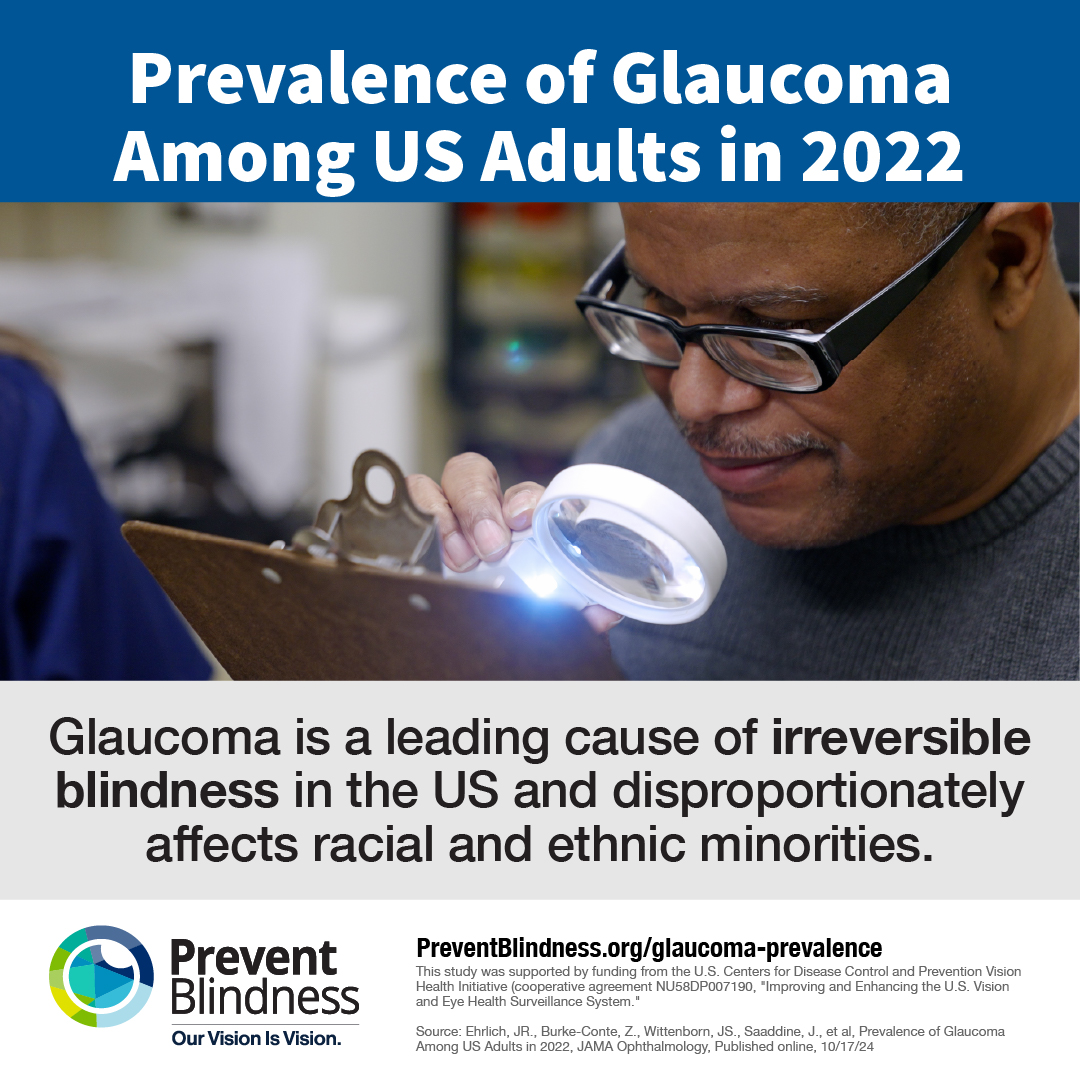
A new study “Prevalence of Glaucoma Among US Adults in 2022” published in JAMA Ophthalmology, found that approximately 4.22 million people in the United States have glaucoma (1.62% of adults ages 18 and older), and 1.49 million people (0.57% of adults ages 18 and older) have vision-affecting glaucoma, with substantial variation in prevalence across demographic subgroups, U.S. states, and counties in 2022. Among those ages 40 and older, 2.56% have glaucoma and 0.91% have vision-affecting glaucoma. Previous estimates of glaucoma prevalence published in 2016 were 2.1% of adults ages 40 years and older and did not include estimates for those under 40 years old, or estimates of vision-affecting glaucoma.
The new study was authored by researchers from NORC at the University of Chicago (NORC), the Institute for Health Metrics and Evaluation (IHME) at the University of Washington (Seattle), The Department of Ophthalmology and Visual Sciences, University of Michigan, and the Institute for Social Research, University of Michigan, Glaucoma Center of Excellence, Massachusetts Eye and Ear and the Centers for Disease Control and Prevention’s (CDC) Vision Health Initiative, with dissemination support from Prevent Blindness. Funding for this study was provided by the CDC Vision Health Initiative via cooperative agreement NU58DP007190, “Improving and Enhancing the US Vision and Eye Health Surveillance System.” This study leverages new multi-source, composite estimates of the prevalence of glaucoma and vision-affecting glaucoma in the US for individuals aged 18 and older.
Glaucoma is a group of eye diseases which cause loss of sight by damaging the optic nerve. Vision loss begins in periphery, or side vision, and can progress to total vision loss without successful treatment. At present, any vision lost to glaucoma cannot be regained. Vision loss due to glaucoma is also associated with disability, loss of independence, and declines in overall health and wellbeing. Because there are often no early symptoms, half of people with glaucoma do not know they have the eye disease, according to CDC. Although there is no cure for glaucoma, early detection and treatment may prevent or delay permanent vision loss.
“Up-to-date estimates of how many people have glaucoma in a certain area are vital for addressing the problem. This kind of information if important for formulating evidence-based policy and public health solutions” said Dr. Joshua Ehrlich, M.D., first author of the study.
Additional key findings from the study include:
• Black individuals are about 3 times as likely to have vision-affecting glaucoma as compared to White individuals.
• An estimated 1.94 million individuals with male sex/gender and 2.29 million individuals with female sex/gender are living with glaucoma.
• One in about 180 adults have vision loss from glaucoma, with risk increasing with age.
• Rates of glaucoma vary by location, with Mississippi having the highest glaucoma prevalence rate (1.95 percent), and Utah the lowest (1.11 percent).
While the study identifies populations at increased risk of glaucoma, additional factors that contribute to vision loss from glaucoma include limited access to eye care, inability to afford necessary treatments, presence of other chronic conditions, family history of glaucoma, and inadequate education about the disease, causes, and need for early intervention. The updated prevalence estimates provided by this study can help inform the development, prioritization, and evaluation of public health strategies to address glaucoma, allocate resources, and tailor public health strategies to the groups most affected.
“These new glaucoma prevalence data can help inform policy planning related to vision health and will be valuable as states and localities work to support their aging populations,” said John D. Omura, M.D., a co-author of the study and a medical officer at CDC.
Study estimates were developed using data within CDC’s Vision and Eye Health Surveillance System (VEHSS). The VEHSS uses new and existing data sources to help health professionals, researchers, policy makers, and patients understand the scope of vision loss, eye disorders, and eye care services in the United States.
“These estimates mark the fourth set of national, state, and county level estimates created by the Vision and Eye Health Surveillance System, joining previously published estimates of vision impairment and blindness, age-related macular degeneration, and diabetic retinopathy. Collectively, these estimates expand our understanding of which Americans experience vision loss, blindness and the major diseases that cause vision problems,” said David B. Rein, PhD, Principal Investigator of VEHSS, and NORC Senior Fellow.
“To estimate the national prevalence of glaucoma and vision-affecting glaucoma, we used methods developed as part of the Global Burden of Disease Study, which is the most comprehensive study of its kind. These estimates are critical to understand the impact of glaucoma, how trends are changing, and how policymakers can take action with these results,” said Dr. Abraham Flaxman, Associate Professor at IHME, who led the statistical modeling on the paper.
Prevent Blindness also offers a variety of free educational and support materials on glaucoma, including a dedicated webpage, fact sheets, and information on glaucoma financial assistance programs in English and Spanish, at https://preventblindness.org/glaucoma-help.
And, Prevent Blindness and Responsum Health offers patients and caregivers “The Glaucoma Community,” a free, digital education platform and mobile app. The comprehensive program offers a webpage, personalized newsfeed, “Community Chat,” a Patient One-Sheet designed for patients to record medical information and share with their physicians, and much more. Program partners of The Glaucoma Community include the BrightFocus Foundation, The Glaucoma Foundation, Glaucoma Research Foundation, and the National Medical Association (NMA) Ophthalmology Section.
“The data from the ‘Prevalence of Glaucoma Among US Adults in 2022’ study demonstrates that now, more than ever, is the time to dedicate resources to help the growing number of glaucoma patients obtain access to eye care to help save vision from the ‘Silent Thief of Sight,’” said Jeff Todd, president and CEO of Prevent Blindness.
For more information on the “Prevalence of Glaucoma Among US Adults in 2022” study or the VEHSS, visit https://www.cdc.gov/vision-health-data/. Or visit the Prevent Blindness page at https://preventblindness.org/glaucoma-prevalence/. For information on glaucoma, please visit PreventBlindness.org/glaucoma.
About NORC at the University of Chicago
NORC at the University of Chicago conducts research and analysis that decision-makers trust. As a nonpartisan research organization and a pioneer in measuring and understanding the world, we have studied almost every aspect of the human experience and every major news event for more than eight decades. Today, we partner with government, corporate, and nonprofit clients around the world to provide the objectivity and expertise necessary to inform the critical decisions facing society.
www.norc.org
About the Institute for Health Metrics and Evaluation
The Institute for Health Metrics and Evaluation (IHME) is an independent global health research organization at the University of Washington School of Medicine that provides rigorous and comparable measurement of the world’s most important health problems and evaluates the strategies used to address them. IHME is committed to transparency and makes this information widely available so that policymakers have the evidence they need to make informed decisions on allocating resources to improve population health. Learn more about IHME: https://www.healthdata.org/
About the University of Michigan
The University of Michigan is recognized as a leading university globally across disciplines. It ranks second among U.S. public institutions and in the top 10 overall as a recipient of NIH research funds. The Department of Ophthalmology and Visual Sciences is one of the top ranked departments in the country for both NIH funding and clinical care. With over $80 million annually in funded awards, the Institute for Social Research (ISR), is the world’s largest academic social science survey and research organization, a leader in developing and applying new social science methods and committed to educating the next generation of social scientists.
About Mass Eye and Ear
Massachusetts Eye and Ear, founded in 1824, is an international center for treatment and research and a teaching hospital of Harvard Medical School. A member of Mass General Brigham, Mass Eye and Ear specializes in ophthalmology (eye care) and otolaryngology–head and neck surgery (ear, nose and throat care). Mass Eye and Ear clinicians provide care ranging from the routine to the very complex. Also home to the world’s largest community of hearing and vision researchers, Mass Eye and Ear scientists are driven by a mission to discover the basic biology underlying conditions affecting the eyes, ears, nose, throat, head and neck and to develop new treatments and cures. In the 2023–2024 “Best Hospitals Survey,” U.S. News & World Report ranked Mass Eye and Ear #4 in the nation for eye care and #7 for ear, nose and throat care. For more information about life-changing care and research at Mass Eye and Ear, visit our blog, Focus, and follow us on Instagram, Twitter and Facebook.
About the CDC’s Vision Health Initiative
CDC is the nation’s leading science-based, data-driven, service organization that protects the public’s health. CDC works 24/7 to protect America from health, safety and security threats, both foreign and in the U.S. CDC’s Vision Health Initiative (VHI) works to improve vision health in the U.S. through collaborations with state and national partners to strengthen science and develop interventions that promote eye health and prevent vision loss and blindness in groups at high risk. VHI also seeks to address risk factors like glaucoma, reduce disparities in vision loss and eye disease, and improve health and quality of life for people with vision loss. VHI designs and implements public health surveillance at the national, state, and county level, supports applied public health research, and promotes the dissemination of evidence-based vision health interventions. In collaboration with state and community partners, VHI works to integrate vision health activities into broader public health strategies and interventions. For more information, visit www.cdc.gov/visionhealth.