





Join the Leading Global Eye Health Alliance.
Membership-
Choose an alternate language here
- Membership

Eversight announced that Diane Hollingsworth has been named President/CEO of the nonprofit eye bank network, effective immediately.
Hollingsworth has served as interim President/CEO since March 5. She joined Eversight in 2010 as Executive Director for eye bank operations and administration in Illinois, and went on to serve as Vice President of Partner Relations, and most recently Executive Vice President of External Relations.
Her deep experience includes operations management, business and partnership development, fund development, organizational financial management, and business and program transformation. Prior to joining Eversight, Hollingsworth held roles in medical education, grants management and patient education for the National Kidney Foundation of Illinois. She also spent 20 years in senior sales and marketing management positions at IBM, Siemens & Rockwell.
Hollingsworth currently serves as vice chair of the Vision Share Board of Directors and chair of the Gift of Hope Organ & Tissue Donor Network Advisory Board. She also is active with the Eye Bank Association of America, the American College of Healthcare Executives, Donate Life Illinois and the Naperville (Illinois) Noon Lions Club.
The Eversight Board of Directors named Hollingsworth as Eversight President/CEO following a national search that attracted strong candidates from the eye banking, organ donation/transplantation, and greater healthcare communities.
“Throughout the interview process, Diane’s experience, passion and vision stood above all the others,” said Jerry Anderson, Chair, Eversight Board of Directors. “The Board is confident that she is the best choice to lead Eversight as we continue to deliver on our mission – to restore sight and prevent blindness through the healing power of donation, transplantation and research.”
Hollingsworth will work with Eversight’s leadership to develop the organization’s long-term strategy to address a changing eye-banking landscape and guide the organization to new levels of accomplishment in the years ahead.
Prevent Blindness is declaring February as Age-related Macular Degeneration (AMD) and Low Vision Month in an effort to provide education and various expert-approved resources to the public and professionals. This year’s AMD and Low Vision Month is generously supported by Gold Sponsor EyePoint, Inc.
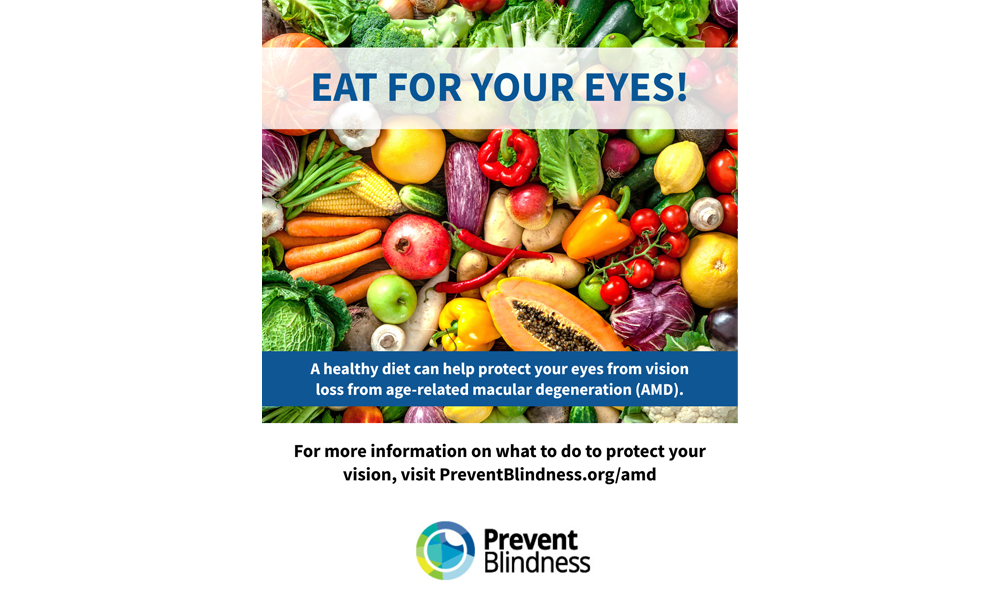
According to Johns Hopkins Medicine, AMD is the most common cause of severe loss of eyesight among people 50 and older. And, about 4 million Americans live with low vision, which is defined as chronic visual impairment that cannot be corrected with glasses, contact lenses or medical treatments.
AMD affects the central part of the retina called the “macula.” When AMD damages the macula, the center part of a person’s vision may become blurred or wavy, and a blind spot may develop. Early detection and treatment of AMD is key to helping to prevent significant vision loss.
Two types of AMD include:
“As our population ages, the number of individuals impacted by AMD continues to grow. Many will face difficulties doing the things we sometimes take for granted, such as reading, seeing faces, and driving,” said Jeff Todd, president and CEO of Prevent Blindness. “Our robust collection of resources on AMD and low vision are intentionally created to help minimize vision loss and maintain independence for those impacted by AMD while providing effective tools to the public and providers on ways to save sight.”
As part of AMD and Low Vision Month, Prevent Blindness offers the free AMD GuideMe app. This resource provides a customized overview of AMD along with a tailored resource list and suggested steps to help save sight from the eye disease specific to the individual using the GuideMe app. Prevent Blindness offers additional educational resources including fact sheets and shareable social media graphics in English and Spanish, and dedicated webpages.
New this year, as part of the Prevent Blindness ASPECT Patient Engagement Program Member Spotlight Series, graduate Laurie S., shares her experience with AMD, including her family history with the eye disease, how it impacts her daily activities including the ability to read music, and the importance of support groups “Age-related Macular Degeneration: Laurie’s Story.”
Videos in the Prevent Blindness Focus on Eye Health Series include:
The Prevent Blindness “Living Well With Low Vision” program provides useful information to those with low vision, their care partners and healthcare professionals. Content includes self-help guides, resources for vision loss and mental wellness, information on clinical trials, and much more. Living Well With Low Vision is supported by grants from Amgen and Genentech.
For more information on AMD, please visit PreventBlindness.org/amd. For information on geographic atrophy, please visit PreventBlindness.org/geographic-atrophy.
And, for more information on Living Well With Low Vision, or other general eye health information, please visit lowvision.PreventBlindness.org.
For a listing of organizations and services that provide financial assistance for vision care in English or Spanish, please visit https://preventblindness.org/vision-care-financial-assistance-information.