


Join the Leading Global Eye Health Alliance.
Membership-
Choose an alternate language here
- Membership
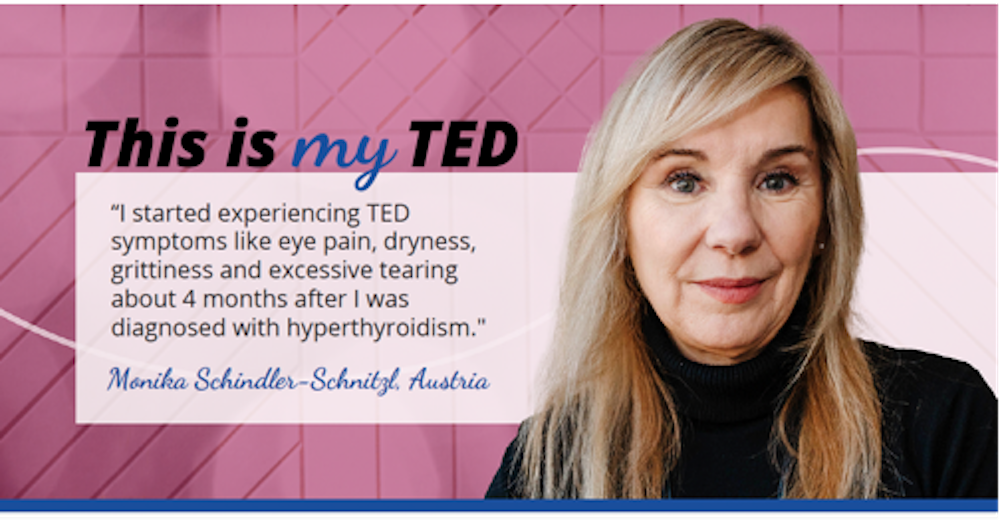
Amgen has launched “This is TED,” an awareness and education campaign designed to increase understanding of Thyroid Eye Disease (TED) and provide patients and carers with access to trusted information and practical support resources.
The launch comes at a time when people living with TED across Europe continue to face challenges of accessing dedicated educational resources. While awareness of TED has increased in recent years, access to TED-specific information and patient support has often been inconsistent across countries, healthcare systems and languages. Through “This is TED”, Amgen in partnership with advocacy groups, including the IAPB, aim to address this unmet need by creating a central destination for disease education, patient stories and support resources.
What is Thyroid Eye Disease?
Thyroid Eye Disease (TED) is a rare, serious and progressive autoimmune disease that affects the tissues and muscles around the eyes.1,2 Often associated with Graves’ disease, TED can cause symptoms such as eye bulging, swelling, redness, pain, double vision and changes in vision.1-4 Individuals are at a higher risk of developing TED if they are a woman, have an autoimmune thyroid condition, smoke, or are aged over 40.5-8
TED is generally characterized by two distinct stages: an active phase, when symptoms may change or worsen, and a chronic phase, when the disease becomes more stable.9,10
Key facts about TED include:
It is important that anyone experiencing these symptoms seeks care quickly to help ensure timely management.10
What is the impact of Thyroid Eye Disease?
The visible and nonvisible symptoms of Thyroid Eye Disease (TED) can have a profound effect on emotional wellbeing and daily activities.2,12 Symptoms of TED can be difficult to cope with, leading some people to feel isolated or experience a drop in self-confidence.12
Research on the impact of TED has shown that:
What Resources Are Available for People Living with TED?
At the center of the awareness campaign is the dedicated “This is TED” platform, which has been developed to provide accessible, patient-friendly information about the condition.
The website offers resources covering:
Making the Invisible Impact of TED More Visible: A Disease with Many Faces
While symptoms and appearance changes can vary from person to person, Thyroid Eye Disease (TED) can affect many aspects of daily life.2,12
This diversity of experiences is reflected in the campaign’s message that TED is a “disease with many faces.” No two journeys are exactly alike, and the impact of TED extends beyond what others may see on the surface.
Through patient stories and educational resources, the campaign aims to help more people understand the realities of living with TED and recognize symptoms earlier. Just as importantly, it highlights experiences that are often overlooked.
To learn more about TED, hear from people living with the condition, and access educational and support resources, please visit: https://www.this-is-ted.com/
Footnotes
*Based on a Graves’ Ophthalmopathy Quality Of Life Questionnaire (GO-QOL) survey of 70 individuals living with TED.
**Based on a longitudinal register study of 862 patients with nontoxic goiter, hyperthyroidism, Graves’ orbitopathy (GO), autoimmune hypothyroidism, or other thyroid diseases observed between 1994–2011.
About This is TED
This is TED is a disease awareness campaign and website, which aims to increase understanding of Thyroid Eye Disease (TED) and provide patients and their carers with a useful and interactive resource. It has been developed in partnership with and validated by TED patients. A range of resources are available to support patients and their carers, including, This is TED flyer, Self-Advocacy Roadmap, TED Symptom Checklist and Patients With Thyroid Eye Disease: A Caregiver’s Guide. Advocacy partners include Thyroid Federation International, Global Healthy Living Foundation, and The International Agency for the Prevention of Blindness.
The campaign has been supported and funded by Amgen.
References