




Join the Leading Global Eye Health Alliance.
Membership-
Choose an alternate language here
- Membership
The International Agency for the Prevention of Blindness (IAPB) has announced that Johnson & Johnson Vision has joined the global eye health body as a Band A Member. Working together, Johnson & Johnson Vision and the IAPB will focus on advocating for better eye health around the world.
“More than 2 billion people worldwide suffer from vision impairment that’s either preventable or treatable. While we’ve come an incredibly long way in terms of treatments and health standards, we have a long road yet to travel,” said Peter Menziuso, Company Group Chairman, Johnson & Johnson Vision. “At Johnson & Johnson Vision, our mission is to make vision possible for patients around the world through innovation, education, and partnership. We are honored to join the IAPB to help advocate for better eye health and know our collective actions — today, tomorrow, and in the future have the potential to improve the future of eye health around the world.”
Peter Holland, CEO of IAPB said, “We are delighted to welcome Johnson & Johnson Vision to the IAPB, joining over 200 organisations working towards a world where no one experiences unnecessary or preventable sight loss and everyone, everywhere can reach their full potential. IAPB and our global membership will greatly benefit from Johnson & Johnson Vision’s knowledge and expertise in areas such as Refractive Error and Cataract and will help enhance our advocacy work and see an end to avoidable sight loss by 2030.”
As well as becoming a member of IAPB, Johnson & Johnson Vision have joined the Love Your Eyes campaign by becoming World Sight Day Global Partners. This year World Sight Day activities, which are co-ordinated by IAPB, its global partners and members will be spotlighting the world of work under the theme of “Love Your Eyes at Work” emphasising the critical importance of prioritising eye health on employee productivity, safety, and overall well-being.
Prevent Blindness is declaring February as Age-related Macular Degeneration (AMD) and Low Vision Month in an effort to provide education and various expert-approved resources to the public and professionals. This year’s AMD and Low Vision Month is generously supported by Gold Sponsor EyePoint, Inc.
According to Johns Hopkins Medicine, AMD is the most common cause of severe loss of eyesight among people 50 and older. And, about 4 million Americans live with low vision, which is defined as chronic visual impairment that cannot be corrected with glasses, contact lenses or medical treatments.
AMD affects the central part of the retina called the “macula.” When AMD damages the macula, the center part of a person’s vision may become blurred or wavy, and a blind spot may develop. Early detection and treatment of AMD is key to helping to prevent significant vision loss.
Two types of AMD include:
“As our population ages, the number of individuals impacted by AMD continues to grow. Many will face difficulties doing the things we sometimes take for granted, such as reading, seeing faces, and driving,” said Jeff Todd, president and CEO of Prevent Blindness. “Our robust collection of resources on AMD and low vision are intentionally created to help minimize vision loss and maintain independence for those impacted by AMD while providing effective tools to the public and providers on ways to save sight.”
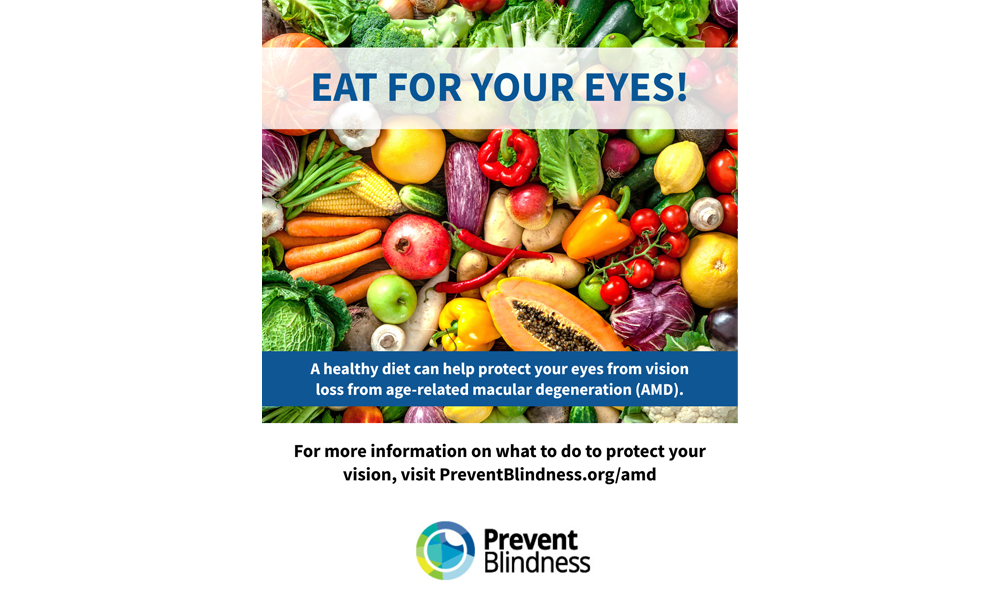
As part of AMD and Low Vision Month, Prevent Blindness offers the free AMD GuideMe app. This resource provides a customized overview of AMD along with a tailored resource list and suggested steps to help save sight from the eye disease specific to the individual using the GuideMe app. Prevent Blindness offers additional educational resources including fact sheets and shareable social media graphics in English and Spanish, and dedicated webpages.
New this year, as part of the Prevent Blindness ASPECT Patient Engagement Program Member Spotlight Series, graduate Laurie S., shares her experience with AMD, including her family history with the eye disease, how it impacts her daily activities including the ability to read music, and the importance of support groups “Age-related Macular Degeneration: Laurie’s Story.”
Videos in the Prevent Blindness Focus on Eye Health Series include:
The Prevent Blindness “Living Well With Low Vision” program provides useful information to those with low vision, their care partners and healthcare professionals. Content includes self-help guides, resources for vision loss and mental wellness, information on clinical trials, and much more. Living Well With Low Vision is supported by grants from Amgen and Genentech.
For more information on AMD, please visit PreventBlindness.org/amd. For information on geographic atrophy, please visit PreventBlindness.org/geographic-atrophy.
And, for more information on Living Well With Low Vision, or other general eye health information, please visit lowvision.PreventBlindness.org.
For a listing of organizations and services that provide financial assistance for vision care in English or Spanish, please visit https://preventblindness.org/vision-care-financial-assistance-information.