




Skip to content

Prevent Blindness Declares Fifth Annual Geographic Atrophy Week as Dec. 1-7, 2025

Published: 27.11.2025
Sarah Hecker Vice President, Marketing
Prevent Blindness
1/1

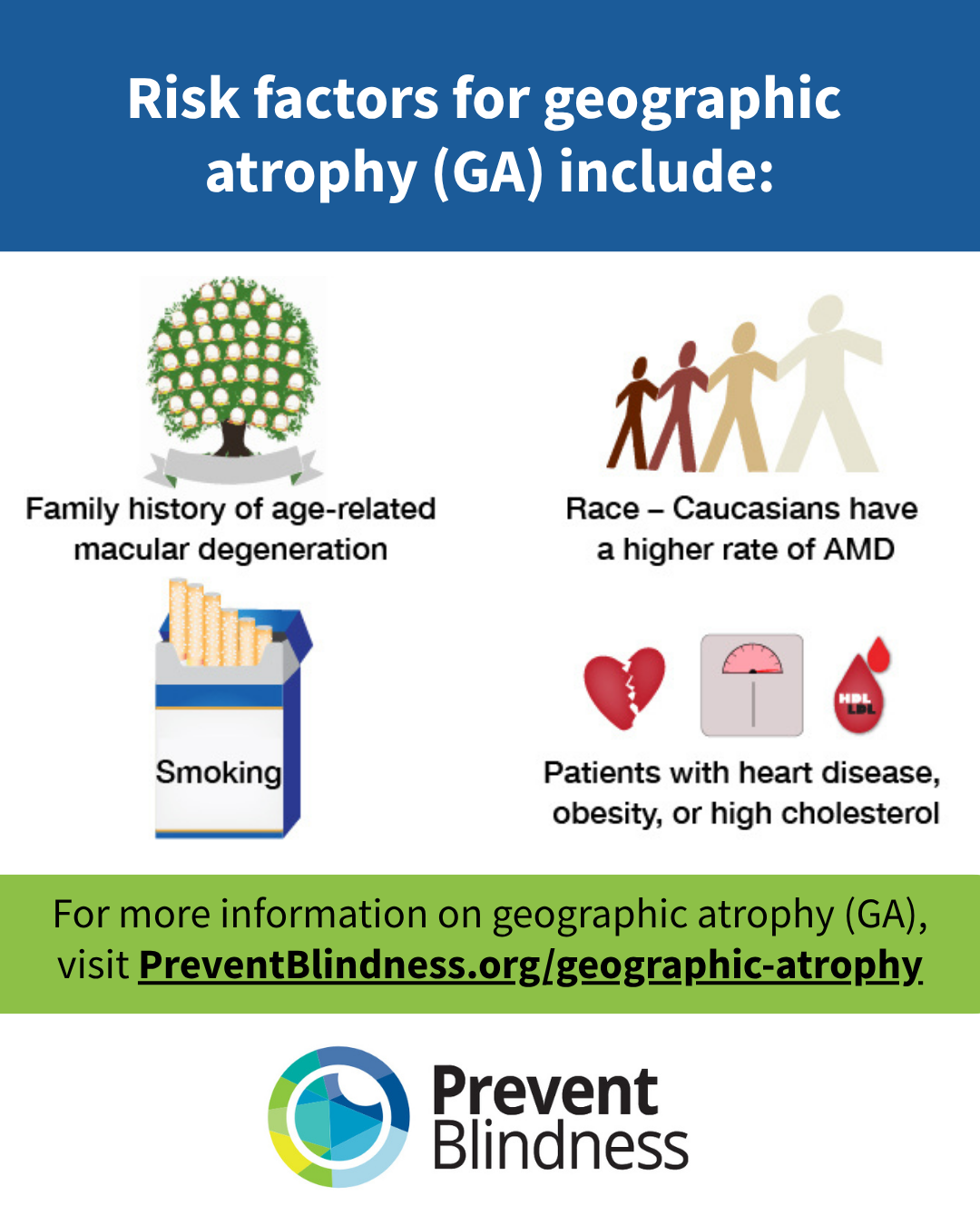
Prevent Blindness has designated December 1-7, 2025 as its fifth annual Geographic Atrophy (GA) Week. GA is an advanced form of dry age-related macular degeneration (AMD). According to the Cleveland Clinic, more than 8 million people in the world, and around 1 million people in the United States have GA. And GA affects around 20 percent of all people with AMD.

To educate the public and allied health professionals, Prevent Blindness offers free, expert-approved educational resources on GA including a fact sheet and a series of social media graphics, available in English and Spanish, a dedicated web page and expert and patient videos. This year’s GA Week is generously supported by Silver sponsor Apellis Pharmaceuticals, Inc.

Vision changes due to GA may include:

  • Difficulty seeing in the center of your vision, which is needed for reading, recognizing faces, and driving
  • Numbers or letters disappearing or missing when reading
  • A dim or dark spot in your central or near central (side) vision
  • Trouble seeing in dim light
  • Needing extra light to read
  • Dull or washed-out colors
  • Vision not as clear or sharp

However, in the early stages of GA, there may be no notable symptoms. This can delay early diagnosis and treatment during a critical period to preserve sight.

“Geographic atrophy can profoundly affect the independence and quality of life of millions of patients and their families,” said Jeff Todd, president and CEO of Prevent Blindness. “Our goal at Prevent Blindness is to bring GA into the spotlight- ensuring people recognize the symptoms, understand their options, and feel empowered to seek care earlier.”

Prevent Blindness recently hosted the community forum “Geographic Atrophy: Knowledge, Hope, and Help,” designed for those who have been diagnosed with GA, and/or their care partners. The discussion, available for viewing free online, includes an overview of GA, patient experiences of individuals living with the condition, and resources available to GA patients. This virtual event was supported by funding from Apellis, Astellas, and Johnson & Johnson.

Panelists of the “Geographic Atrophy: Knowledge, Hope, and Help” forum include:

  • Moderator: Kira Baldonado, MPH, Executive Vice President, Prevent Blindness
  • John W. Kitchens, MD, Retina Specialist, Retina Associates of Kentucky
  • Julie Grutzmacher, MSW, MPH, Director of Patient Advocacy + Population Health Initiatives, Prevent Blindness
  • Diane Marshall, Prevent Blindness ASPECT Patient Engagement Program Graduate, Individual Living with GA
  • Pete Poulsen, Prevent Blindness ASPECT Patient Engagement Program Graduate, Retired Business Communication Coordinator, Individual Living with GA

Additional educational videos from Prevent Blindness include the Focus on Eye Health Series episodes:

  • “Advancements in Treatments for Geographic Atrophy,” featuring Rajeev S. Ramchandran, MD, MBA, Associate Professor of Ophthalmology, Flaum Eye Institute, University of Rochester Medical Center.
    • “Geographic Atrophy and Patient Support,” featuring Prevent Blindness Ohio Past President and CEO, Sherry Williams, sharing her story as a care partner for her mother diagnosed with GA.
  • “Geographic Atrophy” episode featuring Janet S. Sunness, MD, medical director of the Richard E. Hoover Low Vision Rehabilitation Services at the Greater Baltimore Medical Center.

A recent study from the Centers for Disease Control and Prevention found that one in four adults with vision loss reported anxiety or depression. For those experiencing vision loss or blindness from GA, or other eye diseases or conditions, Prevent Blindness offers the Vision Loss and Mental Wellness resource from its Living Well With Low Vision program. Prevent Blindness strongly encourages those experiencing mental wellness issues, and their care partners, to contact a mental health professional, and seek out support groups of others who are living with GA.

For more information on GA, visit https://preventblindness.org/geographic-atrophy. For more information on wet and dry AMD, visit https://preventblindness.org/amd-age-related-macular-degeneration/. For more information on low vision and mental wellness, visit https://lowvision.preventblindness.org.


Photo Credits

Prevent Blindness is declaring February as Age-related Macular Degeneration (AMD) and Low Vision Month in an effort to provide education and various expert-approved resources to the public and professionals. This year’s AMD and Low Vision Month is generously supported by Gold Sponsor EyePoint, Inc.

According to Johns Hopkins Medicine, AMD is the most common cause of severe loss of eyesight among people 50 and older. And, about 4 million Americans live with low vision, which is defined as chronic visual impairment that cannot be corrected with glasses, contact lenses or medical treatments.

AMD affects the central part of the retina called the “macula.” When AMD damages the macula, the center part of a person’s vision may become blurred or wavy, and a blind spot may develop. Early detection and treatment of AMD is key to helping to prevent significant vision loss.

Two types of AMD include:

  • Dry- The most common form of AMD, dry AMD, is caused by the appearance of small yellow deposits called drusen, which form under the retina. These are accumulated waste products of the retina, which can grow and stop the flow of nutrients to the retina. This may cause the retinal cells in the macula that process light to die, causing vision to become blurred. This form of the disease usually worsens slowly. An advanced form of dry AMD is called geographic atrophy.
  • Wet- Wet AMD generally causes more rapid and more serious vision loss. In this form of the disease, tiny new blood vessels grow under and into the retina. These blood vessels are fragile and often break and leak, causing a loss of vision.

“As our population ages, the number of individuals impacted by AMD continues to grow. Many will face difficulties doing the things we sometimes take for granted, such as reading, seeing faces, and driving,” said Jeff Todd, president and CEO of Prevent Blindness. “Our robust collection of resources on AMD and low vision are intentionally created to help minimize vision loss and maintain independence for those impacted by AMD while providing effective tools to the public and providers on ways to save sight.”

As part of AMD and Low Vision Month, Prevent Blindness offers the free AMD GuideMe app. This resource provides a customized overview of AMD along with a tailored resource list and suggested steps to help save sight from the eye disease specific to the individual using the GuideMe app. Prevent Blindness offers additional educational resources including fact sheets and shareable social media graphics in English and Spanish, and dedicated webpages.

New this year, as part of the Prevent Blindness ASPECT Patient Engagement Program Member Spotlight Series, graduate Laurie S., shares her experience with AMD, including her family history with the eye disease, how it impacts her daily activities including the ability to read music, and the importance of support groups “Age-related Macular Degeneration: Laurie’s Story.”

Videos in the Prevent Blindness Focus on Eye Health Series include:

  • “Age-related Macular Degeneration (AMD) and Low Vision,” featuring W. Lloyd Clark, MD, Palmetto Retinal Center, and Assistant Clinical Professor of Ophthalmology at the University of South Carolina School of Medicine.
  • “Low Vision,” featuring R. Tracy Williams, OD, FAAO, Executive Director at Spectrios Institute for Low Vision, Clinical Professor of Ophthalmology, Loyola University and Adjunct Professor, Illinois College of Optometry. Dr. Williams is also a former Prevent Blindness Board of Directors member.
  • “Vision Impairment and Mental Wellness,” with AMD patient Dr. Connie Hills, psychologist, consultant and speaker.

The Prevent Blindness “Living Well With Low Vision” program provides useful information to those with low vision, their care partners and healthcare professionals. Content includes self-help guides, resources for vision loss and mental wellness, information on clinical trials, and much more. Living Well With Low Vision is supported by grants from Amgen and Genentech.

For more information on AMD, please visit PreventBlindness.org/amd. For information on geographic atrophy, please visit PreventBlindness.org/geographic-atrophy.
And, for more information on Living Well With Low Vision, or other general eye health information, please visit lowvision.PreventBlindness.org.

For a listing of organizations and services that provide financial assistance for vision care in English or Spanish, please visit https://preventblindness.org/vision-care-financial-assistance-information.