





Join the Leading Global Eye Health Alliance.
Membership-
Choose an alternate language here
- Membership
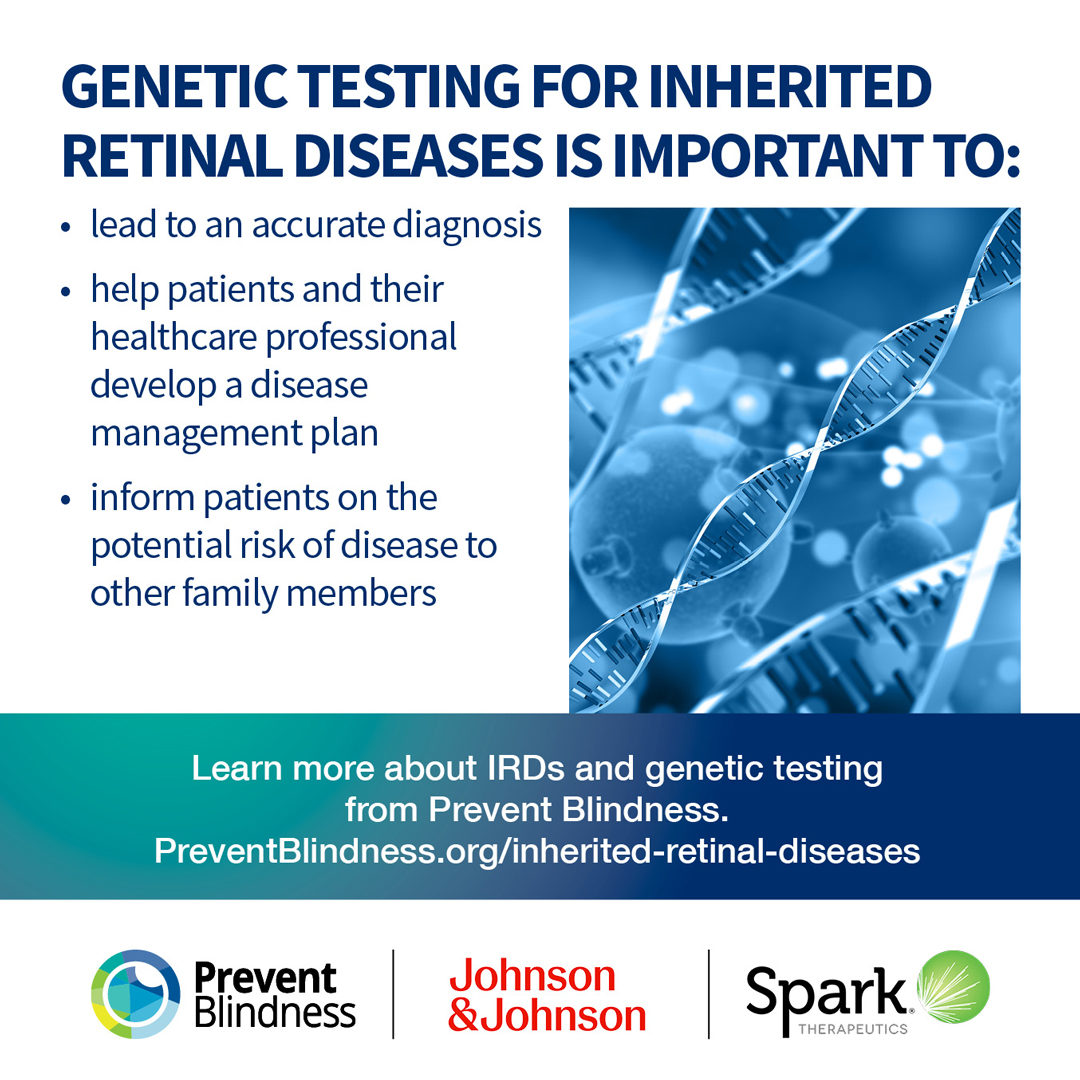
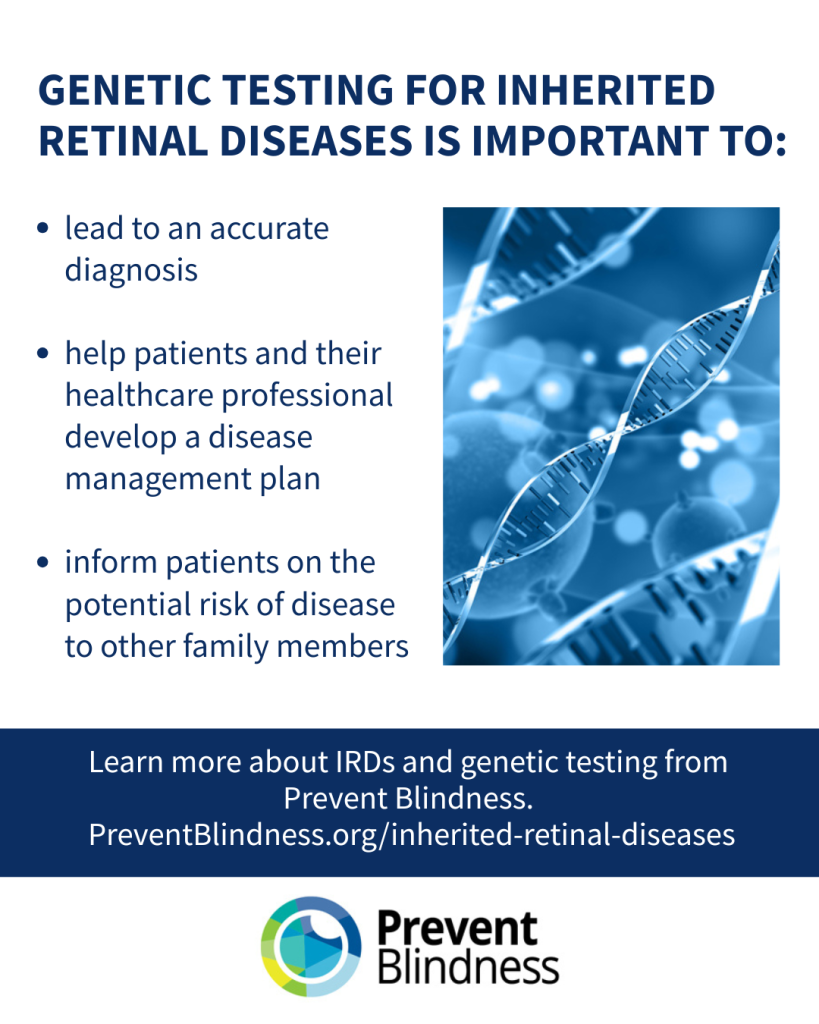
Prevent Blindness, the nation’s leading nonprofit eye health and safety organization, has designated May as “Inherited Retinal Disease (IRD) Genetic Testing Awareness Month,” expanding its previous IRD and Genetic Testing Awareness Week initiative. The group is providing a variety of tools to promote awareness and education for IRDs and the importance of genetic testing, including a free webinar, expert and patient videos, shareable social media graphics, and fact sheets in English and Spanish. IRD Genetic Testing Awareness Month is supported by funding from Johnson & Johnson, and Spark® Therapeutics.
IRD’s are caused by a change in one or more genes and cannot be prevented, according to Duke Health. These mutations change the structure and function of the retina and cause impaired vision, and in some cases, complete vision loss. Additionally, IRDs can affect individuals of all ages, can progress at different rates, and are rare. Genetic testing is available to identify many gene variants that cause IRDs.
While there are many IRDs, they include:
Choroideremia- a progressive loss of cells in the retina, the light-sensitive layer of tissue at the back of the eye, and the nearby network of blood vessels, called the choroid.
Cone-rod Dystrophy- a group of more than 30 IRDs that affect the cones and rods, the light sensitive cells found in the retina.
Leber Congenital Amaurosis- a rare disorder that affects both the peripheral rod cells, central cone cells, and is the most common cause of inherited blindness in childhood.
Retinitis Pigmentosa (RP)- also known as hereditary retinal dystrophy, a group of related eye disorders caused by variations in 60 genes that affect the retina. It is the most common inherited disease of the retina.
Stargardt Disease- also called Stargardt macular dystrophy, the disease causes damage to the macula, a small area in the center of the retina that is responsible for sharp, straight-ahead vision. The disease typically causes central vision loss during childhood or adolescence.
Later in May, Prevent Blindness will establish a dedicated webpage, new fact sheets, an expert video, and resources, to provide education and support for those with Stargardt Disease, made possible with support from Alkeus Pharmaceuticals.
On Wednesday, May 29, at 2 p.m. ET, the National Center for Children’s Vision and Eye Health at Prevent Blindness will be hosting the free webinar, “Pathway to Diagnosis: Genetic Testing for Inherited Retinal Diseases.” This webinar is specifically tailored for families of children with inherited retinal diseases and visual impairment, patient support organizations, school nurses, early childhood program staff including Head Start, Early Intervention and special education professionals, teachers of students with visual impairments, and healthcare providers. This webinar is supported by funding from Johnson & Johnson.
Panelists to include:
• Dawn DeCarlo, OD, PhD, (Moderator) CEO of Sight Savers America and previous Director of University of Alabama’s Center for Low Vision Rehabilitation
• Donna Hunt Hodge, MBA, Director of Marketing & Sales Retina Gene Therapies, Johnson & Johnson
• Natario Couser, MD, board-certified in Ophthalmology and Medical Genetics and Genomics
• Rachelle Lin, OD, MS, FAAO, Assistant Professor at Southern California College of Optometry at Marshall B Ketchum University
• Ben Shaberman, MA, MS, Vice President, Science Communications, Foundation Fighting Blindness
Patient perspectives to be provided by Joy Thomas and Adriann Keve, graduates of the Prevent Blindness ASPECT Patient Engagement Program.
As part of its Focus on Eye Health Expert Series, Prevent Blindness offers the episode, “Inherited Retinal Disorders and Genetic Testing,” with Alina V. Dumitrescu, M.D., Clinical Associate Professor of Ophthalmology and Visual Sciences, Pediatric Ophthalmology and Strabismus, Inherited Eye Disease at the University of Iowa Hospitals and Clinics.
IRD patient testimonials include RP patient Brenda Niccum, and cone dystrophy patient Mariagrazia Buttitta, who share their specific vision issues and vision impairment journeys.
Additionally, Johnson & Johnson offers the free EyesOnGenes resource, a comprehensive website for patients and health care providers with information on IRDs, genetic testing benefits, community resources and more. Spark Therapeutics offers the Eye Want 2 Know® educational resource, dedicated to helping patients understand the genetic causes of IRDs and the potential benefits of genetic testing.
“Although there are currently no cures for inherited retinal diseases, vision loss can be lessened in some cases if IRDs are detected and treated early,” said Jeff Todd, president and CEO of Prevent Blindness. “Through genetic testing, improving access to eyecare, and committing to ongoing vision research, we can help save sight for adults and children with IRDs now and into the future.”
For more information on IRDs and genetic testing for vision issues, visit PreventBlindness.org/inherited-retinal-diseases. To register for the “Pathway to Diagnosis: Genetic Testing for Inherited Retinal Diseases” webinar, visit PreventBlindness.org/IRD-webinar-2024. For a listing of vision care financial assistance programs in English or Spanish, visit PreventBlindness.org/vision-care-financial-assistance-information.