




Join the Leading Global Eye Health Alliance.
Membership-
Choose an alternate language here
- Membership
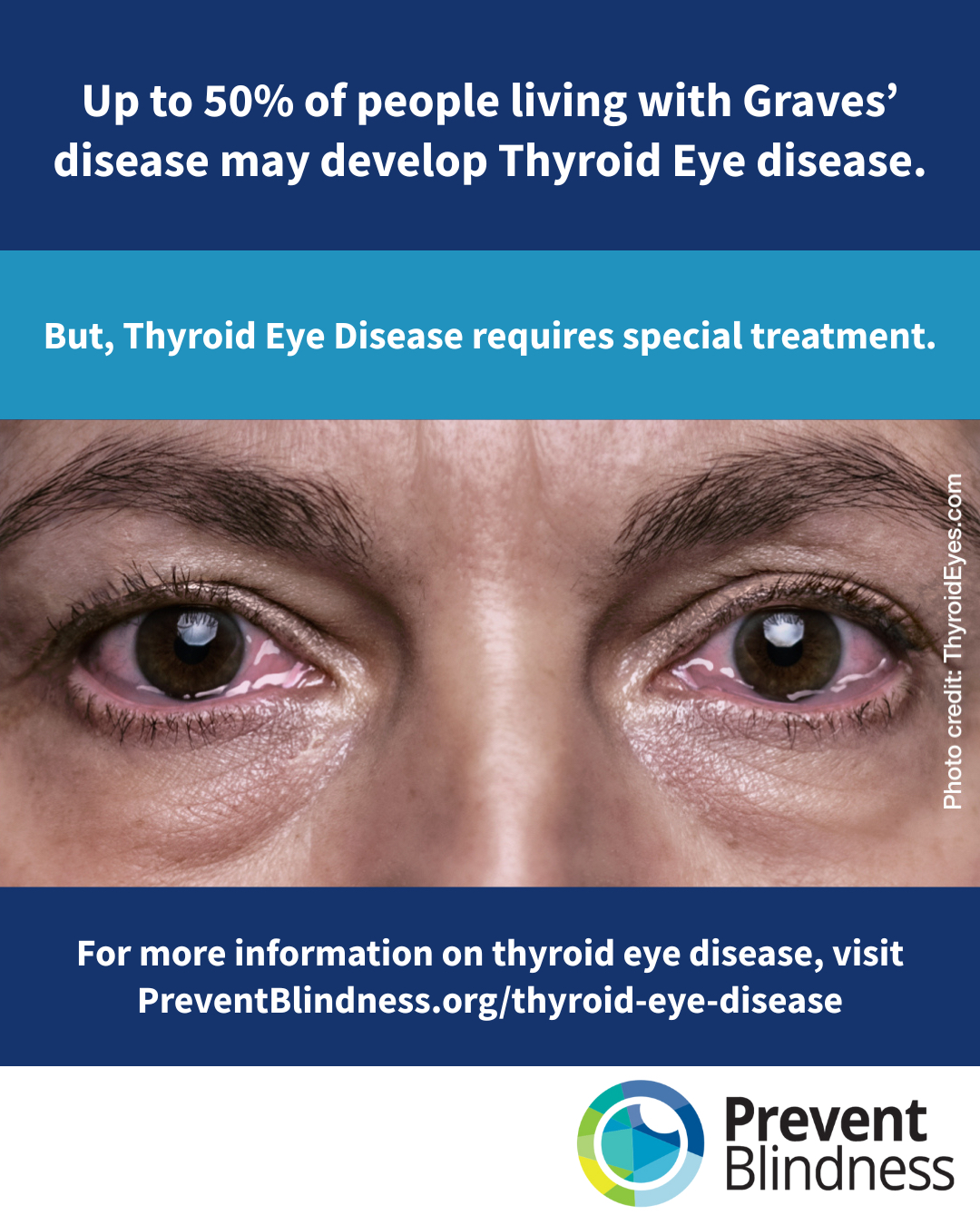
Prevent Blindness has declared its sixth annual Thyroid Eye Disease (TED) Week as Nov. 10-16, 2025. This year’s TED Week is generously supported by Platinum sponsors Amgen and Viridian Therapeutics.
TED is a disease that can occur on its own, or it can occur as a secondary condition due to Graves’ Disease, an autoimmune disorder that occurs when the immune system attacks the thyroid, leading to hyperthyroidism, according to the National Eye Institute. Graves’ disease can cause serious health problems, including TED.
The main symptoms of TED include eye pain, irritation, redness, double vision, inflammation and an increase in the muscle and fat behind the eye, often causing the eyeballs to push forward. In severe cases, the inflammation and increase in the tissues, muscles, and fat behind the eye compress the optic nerve, the nerve that connects the eye to the brain, causing vision loss. The impacts of TED may lead to negative effects on mental health including depression, anxiety, social isolation, loss of independence, and reduced self-confidence.
Risk factors of TED include:
• Age: Usually affects middle-aged adults but can occur at any age
• Gender: Females are affected more than males
• Family history of thyroid eye disease
• Smoking: Smoking increases the risk of thyroid eye disease by 7–8 times, causes thyroid eye disease to have a longer “active phase,” and reduces the effectiveness of treatments
• Low blood levels of selenium, a dietary mineral
• Low blood levels of vitamin D
• Graves’ Disease
• Radioactive iodine therapy: Radioactive iodine has been used to treat hyperthyroidism and Graves’ disease. This treatment should be used with caution in people with TED as it may worsen the condition unless steroids are given at the same time
Prevent Blindness offers a variety of free expert-approved TED educational resources, including comprehensive fact sheets and social media graphics, available in English and Spanish, and a dedicated webpage. Additional resources to support awareness about vision loss and mental wellness can be found on the Prevent Blindness Living Well with Low Vision resource.
As part of World Sight Day on Oct. 9, 2025, Prevent Blindness and the Vision Health Advocacy Coalition (VHAC) produced the “Thyroid Eye Disease: Can I Talk About My Eyes?” webinar. This informative webinar, featuring endocrinologist Dr. Sonalika Khachikian and TED patient Ronda Lynch, included discussions on the importance of eye health in the thyroid community. This virtual event was supported by funding from Amgen.
As part of the collaboration with the VHAC, Prevent Blindness is also offering the new animated video “Did You Know: Thyroid Eye Disease.”
In the new TED patient testimonial video, “Thyroid Eye Disease: Susan’s Story,” Susan R. shares her experience with TED, including how an eye exam led to her TED diagnosis, and her positive experience with the Prevent Blindness ASPECT Patient Engagement program.
The Prevent Blindness Focus on Eye Health Expert Series includes episodes featuring Christine Gustafson, Executive Director and CEO of the TED Community Organization; Prem Subramanian, MD, PhD, Clifford R. and Janice N. Merrill Endowed Chair in Ophthalmology and Vice Chair for Academic Affairs at Sue Anschutz-Rodgers Eye Center, UCHealth; and Sara Wester, MD, FACS, professor of clinical ophthalmology at Bascom Palmer Eye Institute. These may all be found in the Prevent Blindness Thyroid Eye Disease YouTube playlist.
Finally, Prevent Blindness is supporting CONNECTED, the first global virtual conference created by and for people impacted by TED. Hosted by the TED Community Organization, this immersive, weeklong event brings together patients, caregivers, medical experts, advocacy leaders, and industry partners for six days of education, empowerment, and connection.
“Thyroid eye disease brings unique challenges including potential vision loss and changes to a patient’s physical appearance,” said Jeff Todd, president and CEO of Prevent Blindness. “Through early diagnosis and treatment, the negative impact of TED on sight and emotional wellbeing can be significantly lessened.”
For more information on TED, please visit https://preventblindness.org/thyroid-eye-disease/. For a free listing of organizations and services that provide financial assistance for vision care in English or Spanish, please visit https://preventblindness.org/vision-care-financial-assistance-information.