
Skip to content

Prevent Blindness Launches New “Retinopathy of Prematurity (ROP) Education and Support Program” as Part of Inaugural ROP Awareness Week

Published: 28.02.2024
Sarah Hecker Senior Director, Marketing
Prevent Blindness
Prevent Blindness logo
1/1

Prevent Blindness, the nation’s leading eye health and safety nonprofit organization, has launched the new “Retinopathy of Prematurity Education and Support Program,” as part of its first ROP Awareness Week, declared Feb. 26 – March 3, 2024. The group is offering a variety of free educational resources to the public and professionals, including fact sheets, social media graphics in English and Spanish, dedicated online resources, and a new video series.

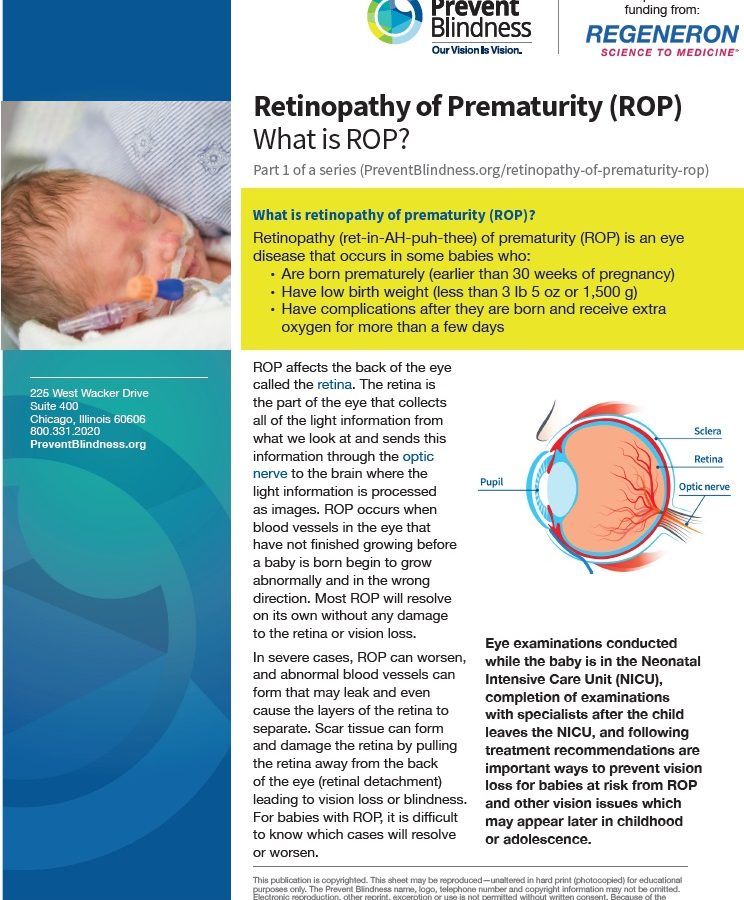
Retinopathy of Prematurity is a condition caused by abnormal development of retinal blood vessels, occurring as a complication of preterm birth and/or low birth weight. ROP may lead to partial or complete vision loss if the condition is severe, and the retina detaches

ROP occurs in some babies who:

  • Are born prematurely (earlier than 30 weeks of pregnancy)
  • Have low birth weight (less than 3 lb. 5 oz.)
  • Have complications after they are born and receive extra oxygen for more than a few days

Alarmingly, a new study from the Centers for Disease Control and Prevention National Center for Health Statistics, “Shifts in the Distribution of Births by Gestational Age: United States, 2014–2022,” shows the preterm birth rate of single births (delivery before 37 completed weeks of pregnancy) rose 12 percent in that time period, while early-term birth rates, at 37 to 38 completed weeks, rose 20 percent.

To help address the need for ROP awareness and education, Prevent Blindness convened leading organizations in the parent support, education, and advocacy arenas to partner on creating the ROP Education and Support Program. Working with partners Hand to Hold, the National Coalition for Infant Health, and the SPAN Parent Advocacy Network, Prevent Blindness led the creation of a variety of expert-approved resources to educate parents and professionals on ROP. The ROP Education and Support Program and ROP Awareness Week is supported by funding from Regeneron.

Prevent Blindness offers a dedicated webpage, PreventBlindness.org/retinopathy-of-prematurity-rop, along with a three-part series of comprehensive fact sheets, addressing questions such as:

  • What is Retinopathy of Prematurity (ROP)?
  • How is ROP Diagnosed and Treated?
  • What Do I Need to Know About My Child’s ROP and Lifelong Vision Health?

In the Prevent Blindness Focus on Eye Health Expert Series, “Retinopathy of Prematurity,” Jeff Todd, president and CEO of Prevent Blindness, interviews R.V. Paul Chan, MD, MSC, MBA, FACS, Head, Department of Ophthalmology and Visual Sciences, The John H. Panton Professor of Ophthalmology, University of Illinois at Chicago College of Medicine, and Director, Pediatric Retina and Retinopathy of Prematurity Service, Illinois Eye and Ear, UI Health. Dr. Chan is also a volunteer member of the Prevent Blindness Board of Directors.

Prevent Blindness recently conducted a roundtable discussion, “Your Child and Retinopathy of Prematurity,” with a pediatric ophthalmologist, psychologist, ROP nurse, child and young adult patients with ROP, parents of children with ROP, and family support organizations. This discussion has been adapted into a video series on topics that include ROP diagnosis and treatment, caregiving and family support, and lifelong vision health of ROP patients. The series is available on the Prevent Blindness website and Prevent Blindness YouTube playlist, containing educational content for both parents and professionals serving families with children with ROP in the Neonatal Intensive Care Unit.
Participants of the roundtable include Dr. Chan, along with:

  • Tiffany Gladdis, PsyD, Division of Developmental and Behavioral Health, Section of Psychology, Division of Neonatology, Medical Director, Office of Equity and Diversity, Children’s Mercy Kansas City, Associate Professor, Department of Pediatrics, UMKC School of Medicine
  • Kelli Kelley, Founder and CEO, Hand to Hold
  • Olachi Mezu-Ndubuisi, MD, OD, Associate Professor of Pediatrics and Ophthalmology, Flaum Eye Institute at the University of Rochester
  • Claudia Perez, BSN, RN, COA, ROP Nurse Coordinator for the Division of Ophthalmology, Ann & Robert H. Lurie Children’s Hospital of Chicago
  • Tracy Pella, Co-Founder and President, Connected Forever, and her son Cooper Pella
  • Nicole Pratt, MAT, BS, Family and Professional Training Director, Leaders Empowered as Advocates with Dignity (LEAD) Project Director, SPAN Parent Advocacy Network
  • Jordan Pratt, an individual with ROP

During ROP Awareness Week, on Tuesday, Feb. 27, at 7 p.m. ET, Blackdoctor.org will stream a new episode dedicated to the discussion of ROP as part of the “Seeing Eye to Eye: Celebrating Eye Health” Facebook Live series. The episode features Charity Grannis, MD, Pediatric Ophthalmologist, Houston Eye Associates, and Dr. Gladdis. This series is a partnership with Blackdoctor.org, Prevent Blindness, the National Eye Institute, and the Children’s Vision Equity Alliance.

“Diagnosing and treating ROP early is essential for preventing or lessening ROP-associated vision loss,” said Mr. Todd. “The ultimate goal for our new ROP program is to educate and offer much-needed resources for families of children with ROP and support the healthcare professionals who care for premature children to help prevent unnecessary vision impairment.”

For more information on ROP, please visit https://preventblindness.org/retinopathy-of-prematurity-rop/, or contact Prevent Blindness at info@PreventBlindness.org.

About Prevent Blindness
Founded in 1908, Prevent Blindness is the nation’s leading volunteer eye health and safety organization dedicated to fighting blindness and saving sight. Focused on promoting a continuum of vision care, Prevent Blindness touches the lives of millions of people each year through public and professional education, advocacy, certified vision screening and training, community and patient service programs and research. These services are made possible through the generous support of the American public. Together with a network of affiliates, Prevent Blindness is committed to eliminating preventable blindness in America. For more information, visit us at PreventBlindness.org, and follow us on Facebook, X, Instagram, Threads, LinkedIn and YouTube.

Prevent Blindness Launches New “Retinopathy of Prematurity (ROP) Education and Support Program” as Part of Inaugural ROP Awareness Week
1/1

Photo Credits

Prevent Blindness is declaring February as Age-related Macular Degeneration (AMD) and Low Vision Month in an effort to provide education and various expert-approved resources to the public and professionals. This year’s AMD and Low Vision Month is generously supported by Gold Sponsor EyePoint, Inc.

According to Johns Hopkins Medicine, AMD is the most common cause of severe loss of eyesight among people 50 and older. And, about 4 million Americans live with low vision, which is defined as chronic visual impairment that cannot be corrected with glasses, contact lenses or medical treatments.

AMD affects the central part of the retina called the “macula.” When AMD damages the macula, the center part of a person’s vision may become blurred or wavy, and a blind spot may develop. Early detection and treatment of AMD is key to helping to prevent significant vision loss.

Two types of AMD include:

  • Dry- The most common form of AMD, dry AMD, is caused by the appearance of small yellow deposits called drusen, which form under the retina. These are accumulated waste products of the retina, which can grow and stop the flow of nutrients to the retina. This may cause the retinal cells in the macula that process light to die, causing vision to become blurred. This form of the disease usually worsens slowly. An advanced form of dry AMD is called geographic atrophy.
  • Wet- Wet AMD generally causes more rapid and more serious vision loss. In this form of the disease, tiny new blood vessels grow under and into the retina. These blood vessels are fragile and often break and leak, causing a loss of vision.

“As our population ages, the number of individuals impacted by AMD continues to grow. Many will face difficulties doing the things we sometimes take for granted, such as reading, seeing faces, and driving,” said Jeff Todd, president and CEO of Prevent Blindness. “Our robust collection of resources on AMD and low vision are intentionally created to help minimize vision loss and maintain independence for those impacted by AMD while providing effective tools to the public and providers on ways to save sight.”

As part of AMD and Low Vision Month, Prevent Blindness offers the free AMD GuideMe app. This resource provides a customized overview of AMD along with a tailored resource list and suggested steps to help save sight from the eye disease specific to the individual using the GuideMe app. Prevent Blindness offers additional educational resources including fact sheets and shareable social media graphics in English and Spanish, and dedicated webpages.

New this year, as part of the Prevent Blindness ASPECT Patient Engagement Program Member Spotlight Series, graduate Laurie S., shares her experience with AMD, including her family history with the eye disease, how it impacts her daily activities including the ability to read music, and the importance of support groups “Age-related Macular Degeneration: Laurie’s Story.”

Videos in the Prevent Blindness Focus on Eye Health Series include:

  • “Age-related Macular Degeneration (AMD) and Low Vision,” featuring W. Lloyd Clark, MD, Palmetto Retinal Center, and Assistant Clinical Professor of Ophthalmology at the University of South Carolina School of Medicine.
  • “Low Vision,” featuring R. Tracy Williams, OD, FAAO, Executive Director at Spectrios Institute for Low Vision, Clinical Professor of Ophthalmology, Loyola University and Adjunct Professor, Illinois College of Optometry. Dr. Williams is also a former Prevent Blindness Board of Directors member.
  • “Vision Impairment and Mental Wellness,” with AMD patient Dr. Connie Hills, psychologist, consultant and speaker.

The Prevent Blindness “Living Well With Low Vision” program provides useful information to those with low vision, their care partners and healthcare professionals. Content includes self-help guides, resources for vision loss and mental wellness, information on clinical trials, and much more. Living Well With Low Vision is supported by grants from Amgen and Genentech.

For more information on AMD, please visit PreventBlindness.org/amd. For information on geographic atrophy, please visit PreventBlindness.org/geographic-atrophy.
And, for more information on Living Well With Low Vision, or other general eye health information, please visit lowvision.PreventBlindness.org.

For a listing of organizations and services that provide financial assistance for vision care in English or Spanish, please visit https://preventblindness.org/vision-care-financial-assistance-information.