


Join the Leading Global Eye Health Alliance.
Membership-
Choose an alternate language here
- Membership
1. Introduction
Sri Lanka, a lower-middle-income country, has long been recognized for its strong public health indicators and robust preventive healthcare system. Despite these achievements, preventable blindness and visual impairment remain major public health challenges. The National Blindness, Visual Impairment and Disability Survey (2013–2015) reported a blindness prevalence of 1.7% among adults aged 40 years and above, with a substantial proportion attributable to avoidable causes such as cataract, uncorrected refractive errors, and glaucoma. These conditions significantly reduce quality of life, impair productivity, and impose long-term social and economic burdens on individuals, families, and the national health system.
Recent systemic shocks, including the COVID-19 pandemic and the prolonged economic crisis, have further threatened progress in eye health. Constraints on public financing, disruptions in healthcare delivery, and shortages of essential surgical consumables and optical devices disproportionately affected eye care services, which are highly dependent on uninterrupted supply chains. As a result, timely access to screening, treatment, and rehabilitation-particularly in rural, estate, and post-conflict regions, has been severely compromised.
In this context, the absence of a comprehensive, coordinated national programme for the prevention of preventable blindness risks widening inequities and undermining Sri Lanka’s commitment to universal health coverage (UHC). A dedicated national programme is therefore both timely and essential to ensure systematic planning, sustainable financing, equitable service delivery, and alignment with global frameworks such as the WHO Integrated People-Centred Eye Care (IPEC) approach.
2. Northern Sri Lanka: A Scalable Model Towards Universal Eye Health Coverage
Northern Sri Lanka, a predominantly rural and post-conflict province with persistent pockets of poverty, offers a compelling model for addressing avoidable blindness through innovative public–private partnerships. The regional strategy has focused on eliminating the cataract backlog, reducing cataract surgical waiting times to zero, increasing cataract surgical coverage, and embedding sustainability and the Sustainable Development Goals within service delivery.
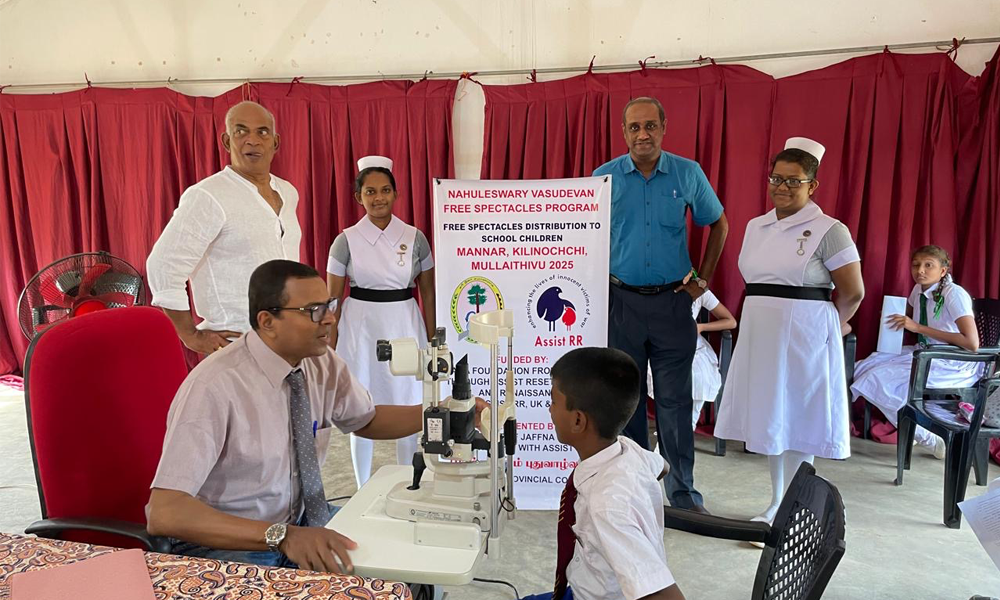
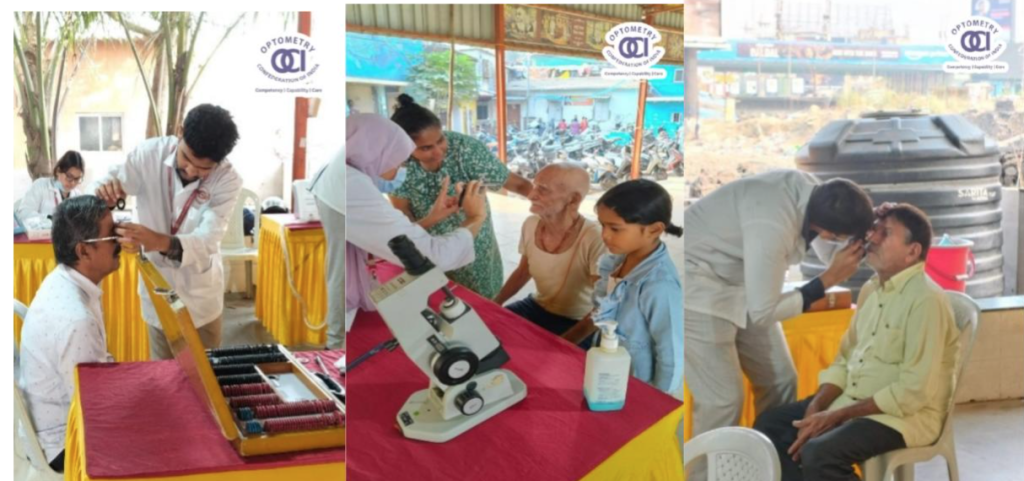
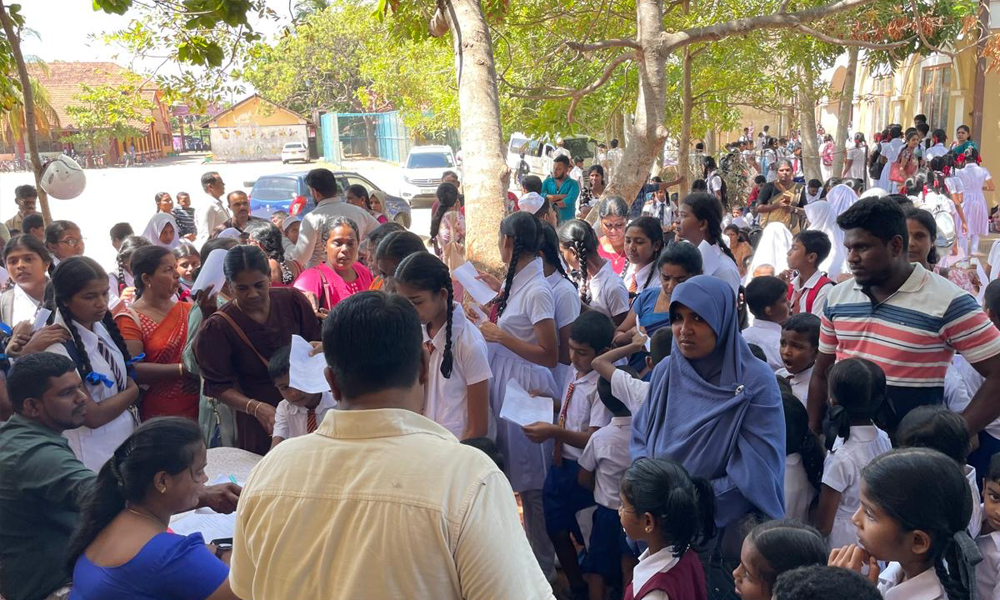
The Eye Unit of Teaching Hospital Jaffna, under the leadership of Dr. M. Malaravan, Consultant Ophthalmologist, has played a central role in operationalizing this model. Beyond providing tertiary-level care, the unit has extended services to underserved populations through outreach screening camps, satellite clinics, and mobile eye care services. Strategic collaboration with the armed forces has enabled access to hard-to-reach communities, ensuring effective referral and back-referral mechanisms. Patients requiring cataract surgery are enrolled in free surgical programmes, supported by transportation, meals, and manpower assistance.
Through these coordinated efforts, the region has achieved a cataract surgical rate of 15 per 1,000 population, eliminated cataract waiting lists, and transformed the existing surgical unit into a high-volume centre using efficient operational strategies aligned with the 5S concept and sustainable healthcare principles. Integration of eye care into primary healthcare services has further strengthened continuity of care.
Targeted interventions have prioritized both ends of the life course-older adults and children, through geriatric cataract surgery programmes and comprehensive school eye screening and free spectacle distribution initiatives. In addition, under the “Clean Sri Lanka” initiative, free eye screening services have been expanded to the general population.
3. Strengthening Evidence Through Research and Data Generation
Clinical service delivery in Northern Sri Lanka has been complemented by a strong emphasis on research and quality improvement. Ongoing studies include evaluations of cataract surgical outcomes, assessments of refractive error patterns among schoolchildren, and blindness and visual impairment surveys among adults aged 40 years and above. These research activities provide critical evidence to guide service improvement and policy development.
However, at the national level, Sri Lanka lacks recent prevalence data on blindness and visual impairment, with no comprehensive national survey conducted since 2016. This data gap limits evidence-based planning, resource allocation, and international benchmarking, underscoring the urgent need for a nationally coordinated eye health information system.
4. Advocacy and Lobbying for Sri Lanka’s Eye Health on International Platforms
Advocacy and strategic engagement at international platforms are essential to elevate Sri Lanka’s eye health agenda and mobilize global support. Establishing a National Programme for the Prevention of Preventable Blindness would position Sri Lanka as a credible and committed partner in global eye health, aligned with the WHO IPEC framework, the World Health Assembly resolutions on eye care, and the Sustainable Development Goals, particularly SDG 3 on good health and well-being.
International advocacy would enable Sri Lanka to showcase successful regional models, such as the Northern Province cataract elimination initiative, as scalable best practices for post-conflict and resource-constrained settings. Active participation in global forums including WHO regional meetings, International Agency for the Prevention of Blindness (IAPB) assemblies, UN side events, and donor roundtables would strengthen visibility, facilitate technical collaboration, and attract sustainable financing and capacity-building support.
Furthermore, coordinated lobbying efforts can promote inclusion of eye health within broader non-communicable disease and ageing agendas, highlight the economic returns of investing in vision, and advocate for integration of eye care into primary healthcare systems globally. A strong national programme would provide the governance structure, data, and accountability mechanisms necessary to support credible international engagement and reporting.
5. Conclusion: A National Imperative with Global Relevance
While Sri Lanka has demonstrated commendable progress in selected regions, the absence of a comprehensive national programme risks fragmentation and inequity in eye care delivery. Implementing a National Programme for the Prevention of Preventable Blindness is critical to consolidating gains, scaling up proven models, strengthening data systems, and ensuring equitable access to quality eye care across the country.
Beyond national benefits, such a programme would enhance Sri Lanka’s ability to advocate effectively for eye health on international platforms, contribute meaningfully to global eye health discourse, and advance universal health coverage. Investing in eye health is not only a health-sector priority but also a strategic development investment with far-reaching social and economic returns.