


Join the Leading Global Eye Health Alliance.
Membership-
Choose an alternate language here
- Membership
Introduction
Access to prescription eyeglasses remains a critical barrier to quality of life in rural communities across Latin America. In Aguanqueterique, Honduras, the Saint Vincent de Paul Medical Mission Team has demonstrated how a sustainable, cost-effective model can transform vision care delivery—achieving a 99.7% success rate while providing prescription glasses for under $5 per pair. .
The Global Vision 2020 Model
Global Vision 2020’s approach centers on three core principles:
Empowerment of existing medical teams: Rather than creating parallel systems, the model enhances the capacity of already-established medical missions by integrating prescription eyeglass services into their existing operations.
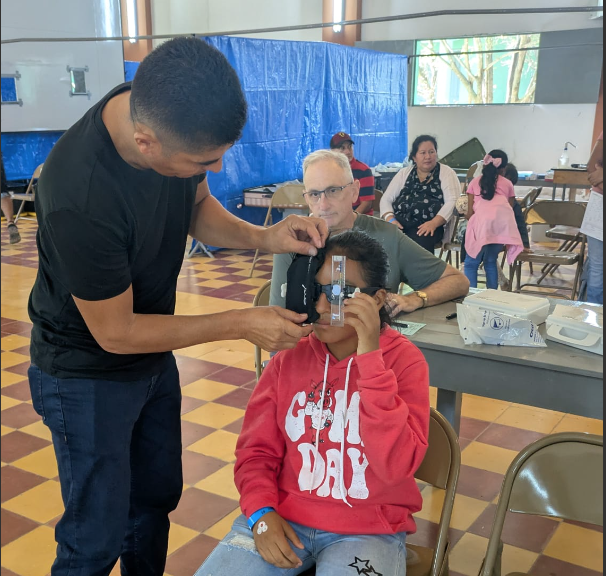
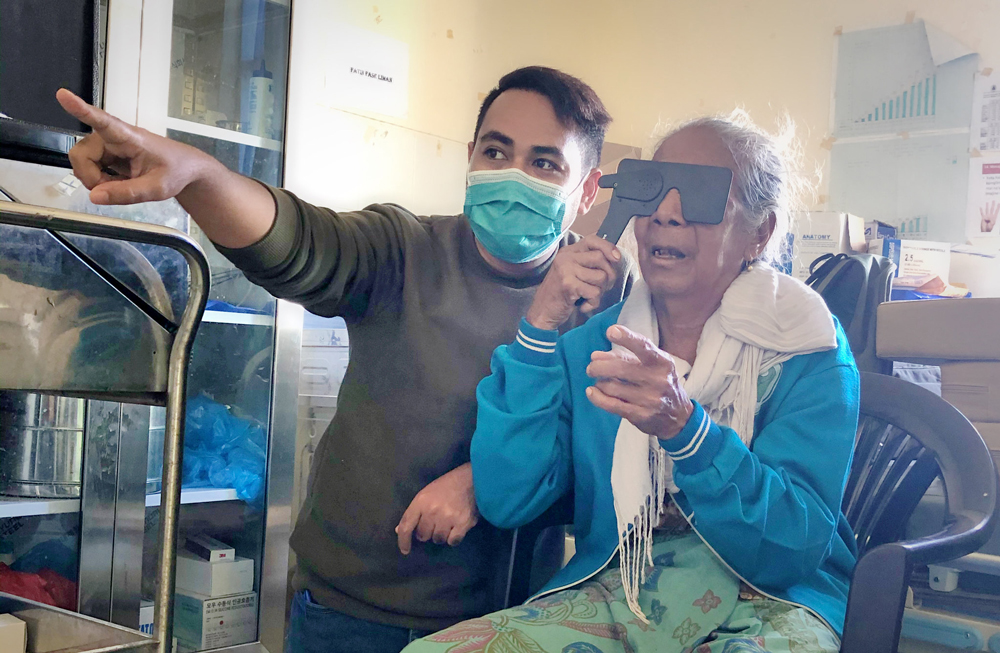
Transferable skills with local inclusion: The system employs an easy-to-use manual refraction tool that can be operated by patients themselves, with training readily transferable to local indigenous workers..
Cost-effectiveness meeting IAPB standards: By assembling glasses on-site with the correct lenses, the model achieves high success rates while maintaining costs under $5 per pair—making quality vision care accessible to underserved populations.
Case Study: Saint Vincent de Paul Honduras Medical Mission
The Saint Vincent de Paul Honduras Medical Mission Team from Fort Wayne, Indiana, exemplifies this model in action. Their journey illustrates both the challenges of traditional approaches and the transformative potential of innovative solutions.
Evolution of Vision Services
The ministry began in 2015 to assist their sister parish in Aguanqueterique, Honduras, starting with medical services and expanding to include dental care in 2017. Initial vision efforts began modestly in 2018 with donated reading glasses from a local Fort Wayne hardware store.
By 2023, the team attempted to address distance vision needs using donated prescription glasses. This approach proved highly ineffective—the proverbial “needle in the haystack.” Challenges included:
The Transformation
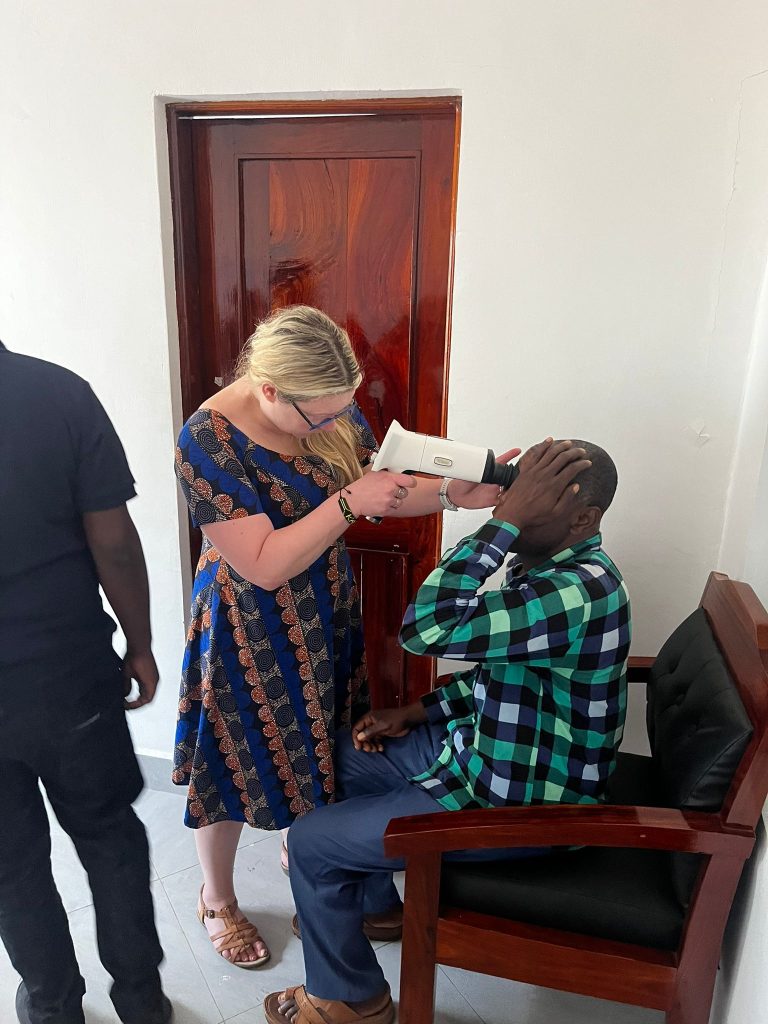
Recognizing the need for a better solution, the team discovered Global Vision 2020. The manual refraction system—operated by patients themselves, followed by on-site assembly of glasses with correct lenses—eliminated the limitations of donated inventory and proved reliable in field conditions.
After training several team members in 2024, results improved dramatically: 246 patients received glasses with a 93% success rate.
November 2025 Mission: Exceptional Outcomes
In November 2025, Greg Wiens joined the Saint Vincent team to both support their program and learn from their field experience. The results exceeded expectations:
Mission Statistics
Identifying Broader Health Needs
The mission also revealed the importance of comprehensive eye health screening. Thirty-four patients were identified with significant pathologies including cataracts and pterygium. Of the four patients who showed no visual improvement, all had severe cataracts. Three of these four were successfully fitted with strong reading glasses that greatly improved their near vision, leaving only one patient without any vision improvement.
This finding underscores the team’s next strategic priority: partnering with an eye hospital in Honduras to establish a referral system for patients requiring ophthalmological care.
Voice from the Field: Fernando Ruiz’s Perspective
Fernando Ruiz, a Saint Vincent de Paul team member, served with the vision group during the November 2025 mission. A husband, father, grandfather, military veteran, and retired 35-year corporate lawyer, Fernando participated in Global Vision 2020 training and shared these reflections:
“For each Honduran brother or sister seeking vision services, my objective was to connect on a personal level, walking with them through the process in Spanish while maintaining the trust
and confidence our longer-tenured teammates have built with the Aguanqueterique community over many years of annual missions.
Although I wear glasses myself, vision is something I have taken for granted. Quickly on our first day of clinic, conversations reminded me that good vision is an invaluable gift—fundamental to one’s opportunity to live a rich, meaningful, and productive life with dignity.
Many patients simply wanted to restore their ability to read the Bible. Two gentlemen serve their Catholic parish as ‘predicadores’ (an essential role involving reading Scripture and preaching in this remote area where priests cannot regularly conduct Mass). Some were unable to read their mobile phone screens. Drivers needed adequate vision for safety. Many proudly identified themselves as ‘ama de casa’ (housewife) and ‘costurera’ (seamstress), having lost their ability to sew and cook. Young people hoped to see the classroom board, continue their studies, and realize dreams of becoming engineers and nurses. One seven-year-old came to us hesitant and nervous, but we later saw her running and playing with her siblings with newfound joy and confidence.
The high level of success we achieved—helping nearly everyone we tested—is nothing short of amazing.”
A Moment of Grace
Fernando shared one particularly moving encounter:
“An elderly woman in her seventies began by grabbing both Tom’s and my hands. With tears, she shared that her husband had just passed away and life was very difficult. She lived alone caring for her 96-year-old mother. Unable to read her Bible, she expressed deep gratitude to God for our mission and prayed for our blessings.
Approximately fifteen minutes later, when we placed lenses on her face and she looked at the reading chart, a beautiful smile filled her face. Her first instinct was to ask for a second set of reading glasses for her mother. I will never forget this life-changing moment.”
Key Takeaways and Future Directions
The Saint Vincent de Paul Honduras Medical Mission demonstrates that sustainable, high-quality vision care is achievable in resource-limited settings when the right model is implemented. Success factors include:
Conclusion
The Honduras experience validates Global Vision 2020’s model as both clinically effective and financially affordable . By empowering existing medical teams with appropriate technology and training, we can dramatically expand access to prescription eyeglasses in underserved communities worldwide. The 99.7% success rate achieved in Aguanqueterique demonstrates what is possible when innovation meets commitment—restoring not just vision, but dignity, productivity, and hope.
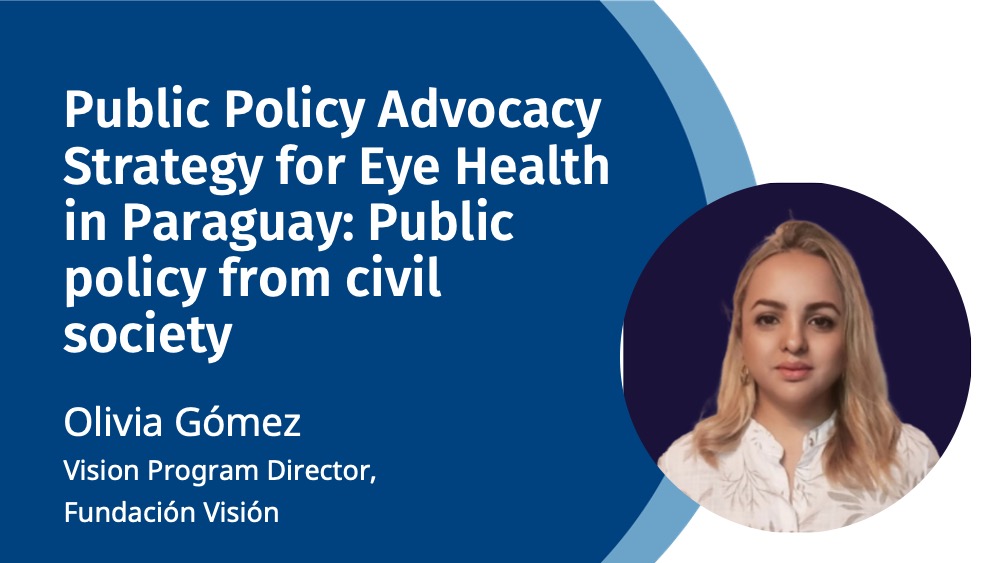
A case study on strengthening public policy on access to comprehensive eye health in the Republic of Paraguay through implementation of targeted strategies.