

Skip to content

May is Inherited Retinal Disease and Genetic Testing Month at Prevent Blindness

Published: 01.05.2026
Sarah Hecker Vice President of Marketing
Prevent Blindness
1/1

Prevent Blindness has designated May as its third annual “Inherited Retinal Disease (IRD) and Genetic Testing Month.” Prevent Blindness offers a variety of free, expert-approved resources on IRDs, including webpages, patient and expert videos, a new podcast episode, social media graphics, and fact sheets in English and Spanish. Prevent Blindness IRD and Genetic Testing Month and Stargardt Disease Week are supported by Gold Sponsors Belite Bio and BlueRock Therapeutics LP, and Silver Sponsor Alkeus Pharmaceuticals.

IRDs are a group of diseases that affect the retina, the layer of cells at the back of the eyeball that converts light into nerve signals, sending those signals along the optic nerve to the brain. The brain processes those signals into the sense of vision, according to the Cleveland Clinic.

Types of IRDS include:
• Achromatopsia
• Choroideremia
• Cone-rod Dystrophy
• Leber Congenital Amaurosis
• Retinitis Pigmentosa (RP)
• Stargardt Disease

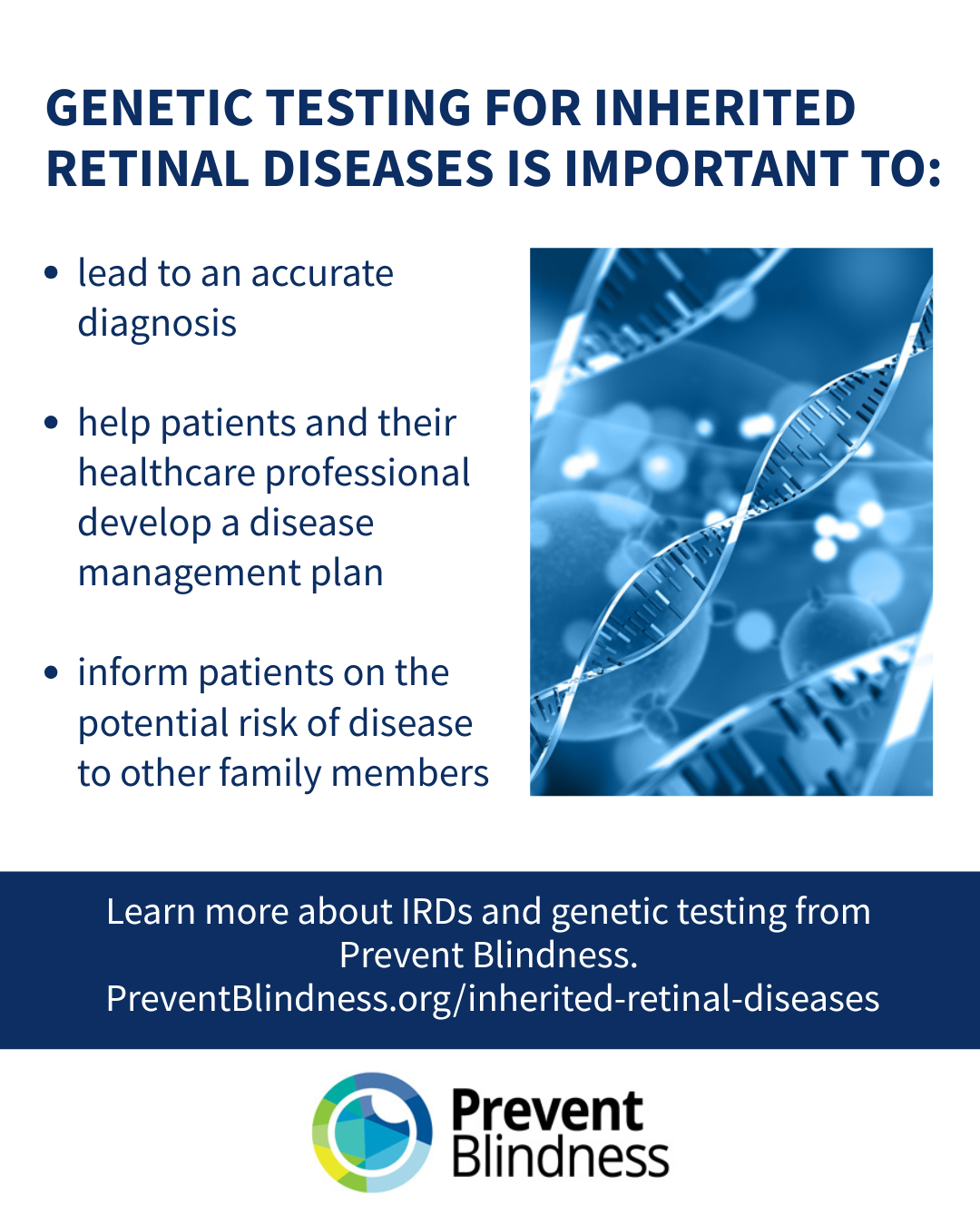
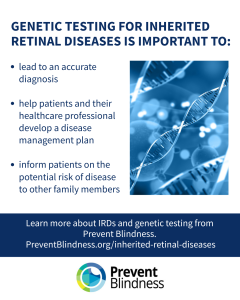
Genetic testing is key to helping doctors identify the disorder early and provide the correct diagnosis and treatment plan. Doctors may also direct patients to participate in clinical trials for therapies that may have the potential to save the patient’s vision.

“Promising research on new sight-saving treatments and therapies is currently underway to help prevent significant vision loss from several IRDs,” said Jeff Todd, president and CEO of Prevent Blindness. “By accessing eyecare and undergoing genetic testing, patients can partner with their healthcare teams to save their sight and provide critical information to their families.”
Once again Prevent Blindness has designated the third week of May, (May 18-24), as Stargardt Disease Week to provide education and support specifically for those with Stargardt disease (also referred to as juvenile macular degeneration). Free resources include a dedicated webpage, social media graphics, fact sheets in English and Spanish, and videos.

New this year, Prevent Blindness is debuting a Stargardt Disease patient video, featuring Havah Fleisner, age 17. She competes in pageants and advocates through her platform, “Through Her Eyes: Living Life Legally Blind.” And, Emmy Award-winning writer and performer Ellen Gould is featured in the May Prevent Blindness Focus on Eye Health Podcast. Ms. Gould discusses the musical she created about her experiences as a person living with Stargardt Disease, titled “Seeing Stars.”

Additional Prevent Blindness IRD videos include:

• “Stargardt Disease: A Conversation with Bryan and Bradford Manning of Two Blind Brothers.”

• “Stargardt Disease,” with Elias Traboulsi, MD, MEd, Pediatric Ophthalmologist and Geneticist, Department of Ophthalmology, Cleveland Clinic.

• “Inherited Retinal Disorders and Genetic Testing,” with Alina V. Dumitrescu, MD, Clinical Associate Professor of Ophthalmology and Visual Sciences, Pediatric Ophthalmology and Strabismus, Inherited Eye Disease at the University of Iowa Hospitals and Clinics.

• RP videos featuring Prevent Blindness ASPECT Patient Engagement Program participants, including Mara Hutchinson, Roshundra Holt, Brenda Niccum, and Kim Owens.

• “Cone Dystrophy” with Prevent Blindness ASPECT Patient Engagement Program participant, Mariagrazia Buttitta.

For more information on IRDs and genetic testing for vision issues, visit PreventBlindness.org/inherited-retinal-diseases. For information on Stargardt disease, visit PreventBlindness.org/stargardt-disease. For a listing of vision care financial assistance programs in English or Spanish, visit PreventBlindness.org/vision-care-financial-assistance-information.

Photo Credits

Prevent Blindness is declaring February as Age-related Macular Degeneration (AMD) and Low Vision Month in an effort to provide education and various expert-approved resources to the public and professionals. This year’s AMD and Low Vision Month is generously supported by Gold Sponsor EyePoint, Inc.

According to Johns Hopkins Medicine, AMD is the most common cause of severe loss of eyesight among people 50 and older. And, about 4 million Americans live with low vision, which is defined as chronic visual impairment that cannot be corrected with glasses, contact lenses or medical treatments.

AMD affects the central part of the retina called the “macula.” When AMD damages the macula, the center part of a person’s vision may become blurred or wavy, and a blind spot may develop. Early detection and treatment of AMD is key to helping to prevent significant vision loss.

Two types of AMD include:

  • Dry- The most common form of AMD, dry AMD, is caused by the appearance of small yellow deposits called drusen, which form under the retina. These are accumulated waste products of the retina, which can grow and stop the flow of nutrients to the retina. This may cause the retinal cells in the macula that process light to die, causing vision to become blurred. This form of the disease usually worsens slowly. An advanced form of dry AMD is called geographic atrophy.
  • Wet- Wet AMD generally causes more rapid and more serious vision loss. In this form of the disease, tiny new blood vessels grow under and into the retina. These blood vessels are fragile and often break and leak, causing a loss of vision.

“As our population ages, the number of individuals impacted by AMD continues to grow. Many will face difficulties doing the things we sometimes take for granted, such as reading, seeing faces, and driving,” said Jeff Todd, president and CEO of Prevent Blindness. “Our robust collection of resources on AMD and low vision are intentionally created to help minimize vision loss and maintain independence for those impacted by AMD while providing effective tools to the public and providers on ways to save sight.”

As part of AMD and Low Vision Month, Prevent Blindness offers the free AMD GuideMe app. This resource provides a customized overview of AMD along with a tailored resource list and suggested steps to help save sight from the eye disease specific to the individual using the GuideMe app. Prevent Blindness offers additional educational resources including fact sheets and shareable social media graphics in English and Spanish, and dedicated webpages.

New this year, as part of the Prevent Blindness ASPECT Patient Engagement Program Member Spotlight Series, graduate Laurie S., shares her experience with AMD, including her family history with the eye disease, how it impacts her daily activities including the ability to read music, and the importance of support groups “Age-related Macular Degeneration: Laurie’s Story.”

Videos in the Prevent Blindness Focus on Eye Health Series include:

  • “Age-related Macular Degeneration (AMD) and Low Vision,” featuring W. Lloyd Clark, MD, Palmetto Retinal Center, and Assistant Clinical Professor of Ophthalmology at the University of South Carolina School of Medicine.
  • “Low Vision,” featuring R. Tracy Williams, OD, FAAO, Executive Director at Spectrios Institute for Low Vision, Clinical Professor of Ophthalmology, Loyola University and Adjunct Professor, Illinois College of Optometry. Dr. Williams is also a former Prevent Blindness Board of Directors member.
  • “Vision Impairment and Mental Wellness,” with AMD patient Dr. Connie Hills, psychologist, consultant and speaker.

The Prevent Blindness “Living Well With Low Vision” program provides useful information to those with low vision, their care partners and healthcare professionals. Content includes self-help guides, resources for vision loss and mental wellness, information on clinical trials, and much more. Living Well With Low Vision is supported by grants from Amgen and Genentech.

For more information on AMD, please visit PreventBlindness.org/amd. For information on geographic atrophy, please visit PreventBlindness.org/geographic-atrophy.
And, for more information on Living Well With Low Vision, or other general eye health information, please visit lowvision.PreventBlindness.org.

For a listing of organizations and services that provide financial assistance for vision care in English or Spanish, please visit https://preventblindness.org/vision-care-financial-assistance-information.