



Join the Leading Global Eye Health Alliance.
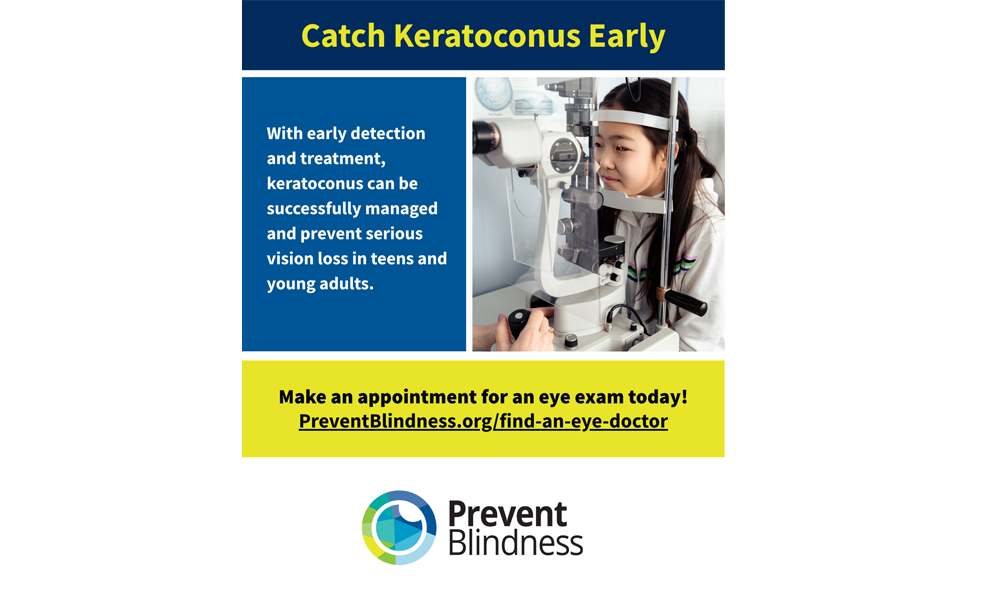
MembershipPrevent Blindness has declared March 23-29, 2026, as its first-ever Keratoconus Week. The group is offering free resources promoted during the week, including a fact sheet, a new flyer “Your Teen’s Blurry Vision Could be a Sign of Keratoconus” in English and Spanish, a dedicated webpage, and social media graphics. The inaugural Prevent Blindness Keratoconus Week is supported by Glaukos.
Keratoconus is an eye disease that results in a thin, weakened cornea. The cornea becomes irregular and stretches, creating a cone-like bulge. The change in the shape of the cornea causes vision to be blurry and distorted.
According to the Moran Eye Center/University of Utah Health, keratoconus is the most common corneal dystrophy in the United States, affecting one in every 2,000 Americans. It is more common in teenagers and adults in their 20s.
Symptoms of keratoconus may include:
Although there is no current cure for keratoconus, sight may be saved if it is detected and treated early. Types of effective treatment include the use scleral lenses or rigid gas permeable contact lenses; corneal crosslinking (CXL), a one-hour treatment that combines riboflavin (Vitamin B) eyedrops and ultraviolet light to halt the progression of keratoconus; and corneal transplants. Transplants are reserved for the most severe cases and is when a diseased cornea is replaced with a clear healthy cornea from a human donor.
“The best ways to save sight from keratoconus and many other eye diseases and conditions is through early detection and access to treatment,” said Jeff Todd, president and CEO of Prevent Blindness. “We encourage patients to team up with their eye doctor to put together an effective treatment plan that meets their specific eye care needs.”
For more information about Keratoconus please visit PreventBlindness.org/keratoconus.
For a listing of organizations and services that provide financial assistance for vision care in English or Spanish, please visit PreventBlindness.org/vision-care-financial-assistance-information.
Prevent Blindness is declaring February as Age-related Macular Degeneration (AMD) and Low Vision Month in an effort to provide education and various expert-approved resources to the public and professionals. This year’s AMD and Low Vision Month is generously supported by Gold Sponsor EyePoint, Inc.
According to Johns Hopkins Medicine, AMD is the most common cause of severe loss of eyesight among people 50 and older. And, about 4 million Americans live with low vision, which is defined as chronic visual impairment that cannot be corrected with glasses, contact lenses or medical treatments.
AMD affects the central part of the retina called the “macula.” When AMD damages the macula, the center part of a person’s vision may become blurred or wavy, and a blind spot may develop. Early detection and treatment of AMD is key to helping to prevent significant vision loss.
Two types of AMD include:
“As our population ages, the number of individuals impacted by AMD continues to grow. Many will face difficulties doing the things we sometimes take for granted, such as reading, seeing faces, and driving,” said Jeff Todd, president and CEO of Prevent Blindness. “Our robust collection of resources on AMD and low vision are intentionally created to help minimize vision loss and maintain independence for those impacted by AMD while providing effective tools to the public and providers on ways to save sight.”
As part of AMD and Low Vision Month, Prevent Blindness offers the free AMD GuideMe app. This resource provides a customized overview of AMD along with a tailored resource list and suggested steps to help save sight from the eye disease specific to the individual using the GuideMe app. Prevent Blindness offers additional educational resources including fact sheets and shareable social media graphics in English and Spanish, and dedicated webpages.
New this year, as part of the Prevent Blindness ASPECT Patient Engagement Program Member Spotlight Series, graduate Laurie S., shares her experience with AMD, including her family history with the eye disease, how it impacts her daily activities including the ability to read music, and the importance of support groups “Age-related Macular Degeneration: Laurie’s Story.”
Videos in the Prevent Blindness Focus on Eye Health Series include:
The Prevent Blindness “Living Well With Low Vision” program provides useful information to those with low vision, their care partners and healthcare professionals. Content includes self-help guides, resources for vision loss and mental wellness, information on clinical trials, and much more. Living Well With Low Vision is supported by grants from Amgen and Genentech.
For more information on AMD, please visit PreventBlindness.org/amd. For information on geographic atrophy, please visit PreventBlindness.org/geographic-atrophy.
And, for more information on Living Well With Low Vision, or other general eye health information, please visit lowvision.PreventBlindness.org.
For a listing of organizations and services that provide financial assistance for vision care in English or Spanish, please visit https://preventblindness.org/vision-care-financial-assistance-information.