







Join the Leading Global Eye Health Alliance.
Membership-
Choose an alternate language here
- Membership
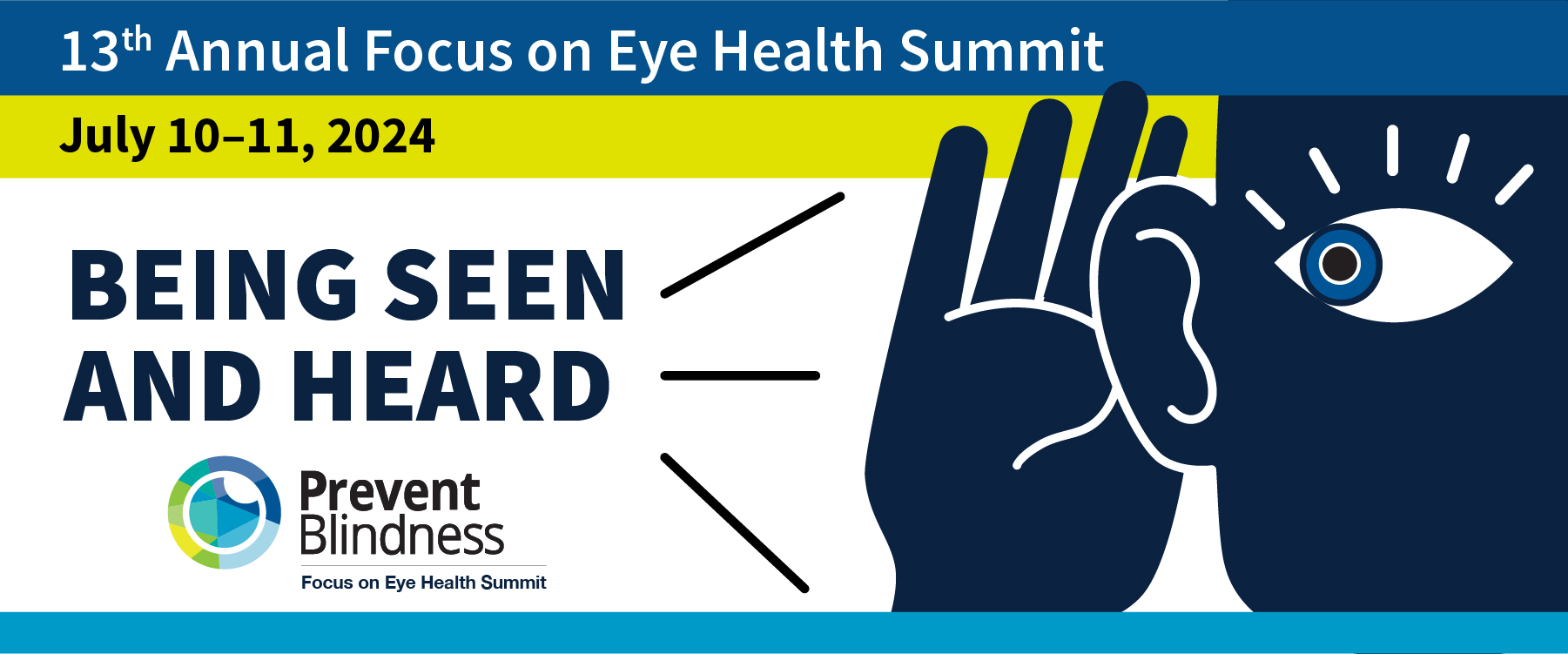
Prevent Blindness, the leading eye health and safety nonprofit organization in the United States, will host the 13th annual Prevent Blindness Focus on Eye Health Summit on July 10-11, 2024, as a virtual interactive event. The theme for this year is “Being Seen and Heard,” with the goal to amplify and educate on the importance of a person-centered approach to vision health interventions, research, communications, and care.
This year’s agenda is specifically designed to address a variety of topics including how social determinants of health contribute to increased or decreased eye health disparities; how innovative strategies, emerging technologies, surveillance, and collaborative approaches promote eye health; and how engaging individuals results in reduced barriers to care as well as more meaningful policy, research, and programs.
Participants and attendees of the Focus on Eye Health Summit include a wide, international audience of patient advocates, community-based organizations, vision and eye health organizations, researchers, public health experts, health-care providers, educators, government agency and legislative staff, corporate partners and more.
All are invited to network using the summit’s chat features and follow the event on Prevent Blindness social media platforms at #EyeSummit.
The Summit will kick-off on Wednesday, July 10, with keynote speaker Stacey B. Lee, JD, Professor of Law and Ethics at the Johns Hopkins University Carey Business School presenting on “The Patient Voice.” Following the presentation will be a reaction panel and discussion.
Additional presentations on day one of the 13th Annual Focus on Eye Health Summit will include:
• Vision Research and the Citizen Scientist
o Moderator: Mabel Crescioni, DrPH, JD, Senior Engagement Officer, Patient-Centered Outcomes Research Institute
o Priscah Mujuru, DrPH, MPH, RN, Health Scientist Administrator, Division of Community Health and Population Science, National Institute on Minority Health and Health Disparities
o Kristen Nwanyanwu, MD, MBA, MHS, Assistant Professor of Ophthalmology and Visual Science, Yale University
• Seeing and Hearing Children’s Vision Needs
o Moderator: Phil Goglas II, MPAP, Managing Partner, Health and Medicine Council
o Sara D. Brown, MPA, Director of Government Affairs, Prevent Blindness
o Karen Woodhouse, Director, Eyes on Learning
Additionally, Prevent Blindness Board of Directors Emeritus member, Sandra S. Block, OD, MEd, MPH, President, World Council of Optometry, Professor Emeritus, Illinois College of Optometry, will formally present the 2024 Jenny Pomeroy Award for Excellence in Vision and Public Health to nonprofit group, Mission for Vision. The fifth annual Prevent Blindness Rising Visionary Award will be presented to Erica Shelton, OD, MS, FAAO, Clinical Instructor and PhD Candidate, The Ohio State University College of Optometry.
July 11, day two of the Prevent Blindness Focus on Eye Health Summit, will begin with a fireside chat on “The Human Side of AI in Healthcare.” Randall L. Rutta, Chief Executive Officer, National Health Council and Brian Anderson, MD, Chief Executive Officer, Coalition for Health AI (CHAI) will have a discussion on the importance of person-centered approaches to artificial intelligence in the future of healthcare.
Additional day two presentations and discussions will include:
• The Many Eyes in Artificial Intelligence
o Moderator: Sally L. Baxter, MD, MSc, Chief for Ophthalmology Informatics and Data Science, University of California San Diego
o Louis R. Pasquale, MD, FARVO, Site Chair, Department of Ophthalmology, Mount Sinai Hospital, Shelley and Steven Einhorn Professor of Ophthalmology, Director, Eye and Vision Research Institute of New York Eye & Ear at Mount Sinai
o Michael Abramoff, MD, PhD, Founder and Executive Chairman, Digital Diagnostics
o Cecilia Lee, MD, MS, Professor of Ophthalmology and the Klorfine Family Endowed Chair, Department of Ophthalmology, University of Washington
o Benjamin Xu, MD, PhD, Associate Professor of Clinical Ophthalmology, Chief of the Glaucoma Service, Director of the Data Science and AI Core at the USC Roski Eye Institute
• Visible Voices: Vignettes of Being Seen and Heard
o Moderator: Julie Grutzmacher, MSW, MPH, Director of Patient Advocacy & Population Health Initiatives, Prevent Blindness
o Larry Johnson, Prevent Blindness ASPECT Patient Engagement Program Graduate
o Joy Thomas, DoubleVision Blog, Prevent Blindness ASPECT Patient Engagement Program Graduate
o Jeanetta Price, Prevent Blindness ASPECT Patient Engagement Program Graduate
The Focus on Eye Health Summit is made available at no cost to attendees thanks to the support of the event sponsors. To date, the Alliance for Aging Research is serving as a Platinum Sponsor. Gold sponsors include Amgen Rare Disease, Apellis Pharmaceuticals, and BIO (Biotechnology Innovation Organization). Silver sponsors are Alexion, American Academy of Ophthalmology, Association for Research in Vision and Ophthalmology, BrightFocus Foundation, The EyeSight Foundation of Alabama, Glaucoma Research Foundation, Johnson & Johnson, Kyowa Kirin, Lions Clubs International Foundation, Mallinckrodt Pharmaceuticals, Patient Access Network (PAN) Foundation, and Research to Prevent Blindness.
“The year’s Focus on Eye Health Summit will once again convene leaders, experts, and stakeholders who are passionate about advancing the vision and eye health of our nation and our world,” said Jeff Todd, president and CEO of Prevent Blindness. “We invite everyone to register today and take part in this significant event and the important dialogue it encompasses!”
To register for the 2024 Prevent Blindness Focus on Eye Health Summit, visit PreventBlindness.org/eyesummit. For information about sponsorship opportunities, please contact Nita Sinha, Director of Public Health, at EyeSummit@PreventBlindness.org.