




Join the Leading Global Eye Health Alliance.
Membership-
Choose an alternate language here
- Membership
Prevent Blindness will host the 14th Annual Prevent Blindness Focus on Eye Health Summit on May 14, 2025, as a free, interactive virtual event. The theme for this year is “Perspectives in Vision,” designed to emphasize the need for a collaborative, multidisciplinary approach to addressing eye health challenges in an evolving world.
The 2025 Summit agenda will address a variety of topics including recent innovations in vision care and technology; public health strategies to reduce preventable blindness; policy frameworks to integrate eye health into broader healthcare systems; and local to global approaches to ensuring access to quality eye care. Attendees will also hear personal stories from patients and care partners to help deepen insights into eye health and educate others on the impact vision loss and blindness has on quality of life.
“We are thrilled to convene the 14th consecutive Prevent Blindness Focus on Eye Health Summit, which provides a unique forum for all those who are champions for vision and eye health programs, research and services,” said Jeff Todd, president & CEO of Prevent Blindness. “The Summit brings together thought leaders, experts and advocates from around the world to discuss best practices and formulate new strategies to promote the importance of healthy vision and the critical need for access to quality eye care.”
The Focus on Eye Health Summit is attended by an expansive, international audience, including patients, patient advocates, eye care practitioners, public health officials, researchers, policymakers, nonprofit and for-profit leaders, corporate partners, and more. As with previous years, all attendees are encouraged to network using various online features as well as following the event on Prevent Blindness social media platforms at #EyeSummit.
The virtual doors will open to the Exhibit Hall for the Focus on Eye Health Summit at 11 a.m. ET. Attendees will be able to download free resources available from Summit event exhibitors, and e-mail communications will be available with exhibit staff. Additionally, some booths will have video and text chat options available.
To date, the following Summit presentations and discussions will include:
Keynote Discussion: Leading the Way- National Lessons in Eye Health Advocacy and Collaboration and Reaction Panel
• Opening remarks and moderator: Jeff Todd, President & CEO, Prevent Blindness
• Jennifer Jones, President & CEO, Fighting Blindness Canada
• Elisabeth Fowler, Executive Director and CEO, Canadian Ophthalmological Society
Reaction Panel: How can we drive meaningful change for vision and eye health in the U.S.?
• Phil Goglas II, MPAP, Managing Partner, Health and Medicine Counsel LLC
• Dan Ignaszewski, Executive Director, Alliance for Eye and Vision Research (AEVR) & National Alliance for Eye and Vision Research (NAEVR)
SESSION 2: Fireside Chat: Factors that Matter in Vision Research
Moderator: Ruth Y. Shoge, OD, MPH, FAAO, Associate Clinical Professor; Director of Diversity, Equity, Inclusion, and Belonging; University of California Berkeley
• M. Roy Wilson, MD, MS; President Emeritus, Wayne State University; Distinguished Professor, Wayne State University School of Medicine
SESSION 3: Putting Advocacy into Action
Moderator: Heather Shirk Patrick, President & CEO, Prevent Blindness Texas
• Leslie Nwankwo, Prevent Blindness ASPECT Patient Engagement Program Graduate
• Abubakar Sadik Mohammed, OD, PhD Student, Vision Science Graduate Program, University of Alabama at Birmingham, Prevent Blindness ASPECT Patient Engagement Program Graduate
• Linda MacLeod, Prevent Blindness ASPECT Patient Engagement Program Graduate
The final session of the day will be “The Future of Diagnosis and Treatment in Eye Care.” The day will also feature the popular Prevent Blindness “Coffee Chats” that provide a venue for attendees to engage in informal and lively discussions around a variety of topics.
To close the Summit, Jeff Todd will formally announce the recipients of the 2025 Jenny Pomeroy Award for Excellence in Vision and Public Health, and the 6th annual Prevent Blindness Rising Visionary Award. Recipients will present during a Prevent Blindness-hosted webinar in the Fall of 2025.
The Focus on Eye Health Summit is made available at no cost to attendees thanks to the generous support of the event sponsors.
For more event information, and to register for the 2025 Prevent Blindness Focus on Eye Health Summit, visit PreventBlindness.org/eyesummit.
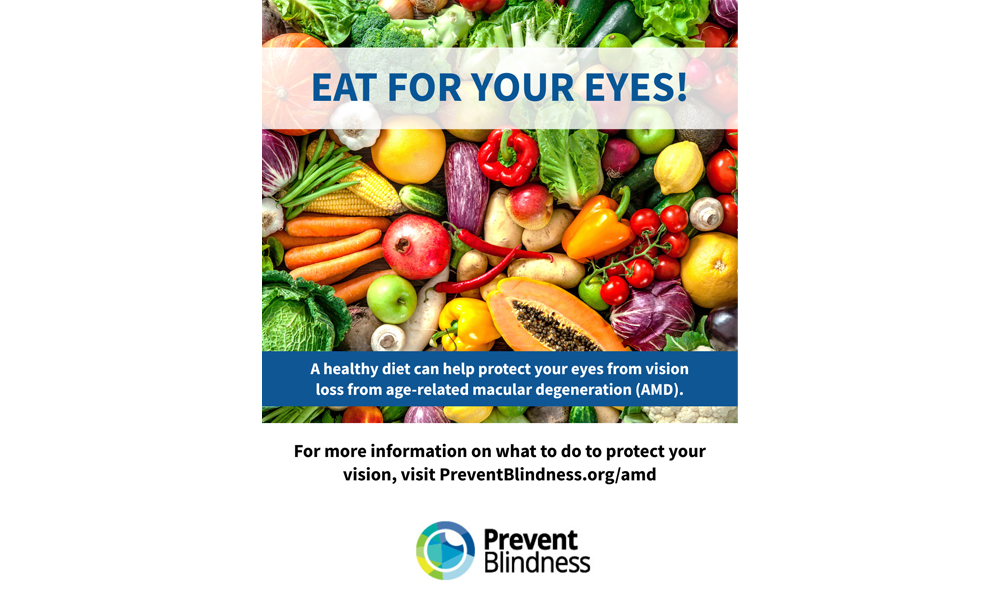
Prevent Blindness is declaring February as Age-related Macular Degeneration (AMD) and Low Vision Month in an effort to provide education and various expert-approved resources to the public and professionals. This year’s AMD and Low Vision Month is generously supported by Gold Sponsor EyePoint, Inc.
According to Johns Hopkins Medicine, AMD is the most common cause of severe loss of eyesight among people 50 and older. And, about 4 million Americans live with low vision, which is defined as chronic visual impairment that cannot be corrected with glasses, contact lenses or medical treatments.
AMD affects the central part of the retina called the “macula.” When AMD damages the macula, the center part of a person’s vision may become blurred or wavy, and a blind spot may develop. Early detection and treatment of AMD is key to helping to prevent significant vision loss.
Two types of AMD include:
“As our population ages, the number of individuals impacted by AMD continues to grow. Many will face difficulties doing the things we sometimes take for granted, such as reading, seeing faces, and driving,” said Jeff Todd, president and CEO of Prevent Blindness. “Our robust collection of resources on AMD and low vision are intentionally created to help minimize vision loss and maintain independence for those impacted by AMD while providing effective tools to the public and providers on ways to save sight.”
As part of AMD and Low Vision Month, Prevent Blindness offers the free AMD GuideMe app. This resource provides a customized overview of AMD along with a tailored resource list and suggested steps to help save sight from the eye disease specific to the individual using the GuideMe app. Prevent Blindness offers additional educational resources including fact sheets and shareable social media graphics in English and Spanish, and dedicated webpages.
New this year, as part of the Prevent Blindness ASPECT Patient Engagement Program Member Spotlight Series, graduate Laurie S., shares her experience with AMD, including her family history with the eye disease, how it impacts her daily activities including the ability to read music, and the importance of support groups “Age-related Macular Degeneration: Laurie’s Story.”
Videos in the Prevent Blindness Focus on Eye Health Series include:
The Prevent Blindness “Living Well With Low Vision” program provides useful information to those with low vision, their care partners and healthcare professionals. Content includes self-help guides, resources for vision loss and mental wellness, information on clinical trials, and much more. Living Well With Low Vision is supported by grants from Amgen and Genentech.
For more information on AMD, please visit PreventBlindness.org/amd. For information on geographic atrophy, please visit PreventBlindness.org/geographic-atrophy.
And, for more information on Living Well With Low Vision, or other general eye health information, please visit lowvision.PreventBlindness.org.
For a listing of organizations and services that provide financial assistance for vision care in English or Spanish, please visit https://preventblindness.org/vision-care-financial-assistance-information.