












Join the Leading Global Eye Health Alliance.
Membership-
Choose an alternate language here
- Membership

Correcting the near vision of garment factory workers with glasses boosted their productivity by 6 per cent, according to new research in factories in India.
Published today in the British Journal of Ophthalmology, the randomised controlled trial found that one in four (27 per cent) sewing machine operators were suffering from poor near vision and did not own a pair of glasses. With corrected vision, they were more productive, making fewer errors and completing more garments.
Providing glasses that correct near vision to textile and garment workers globally, most of whom work in low-income countries in South and Southeast Asia, would increase productivity, and reduce errors and material waste. This would enable the manufacture of 3.8 billion additional items a year, and adding the equivalent of $27 billion annual output to the global industry.
The study was implemented in the field by VisionSpring and Good Business Lab, with academic leadership from Queen’s University Belfast, University of Michigan, and University of California San Diego. It was funded by USAID, The Chen Yet-Sen Family Foundation, and the Livelihood Impact Fund.
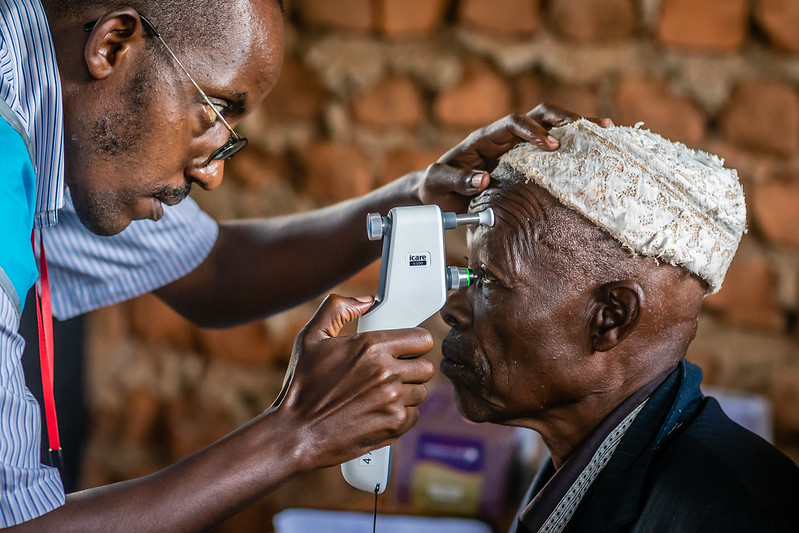
The trial provided free glasses to 344 sewing machine operators in factories owned by Shahi, India’s largest apparel manufacturer, who were experiencing age-related loss of near vision, known as presbyopia.
Avoidable sight loss carries huge economic costs globally, and recent analysis suggests that reaching the 1 billion people living with avoidable sight loss could deliver a USD $447 billion annual boost to the world economy. However, this is the first randomised controlled trial to test the impact of vision correction in a real factory setting.
The full intervention, which included vision screening, provision of glasses that correct near vision, and encouragement to wear the glasses regularly, proved highly cost-effective, costing under USD $10 per worker. It returned USD $3.37 for every USD $1 spent over the three-month trial period – a 337% return on investment that if sustained over 12 months would rise to a projected 1647%.
Shahi Exports has been sufficiently impressed by the results to announce plans to roll out free vision screening across its entire factory workforce of around 100,000 workers.
Immediate productivity gains could provide vital support to struggling factories
The trial has significant implications for the textile and garment manufacturing sector and for millions of factory workers worldwide.
The global apparel industry is under pressure from multiple directions at once. US tariffs are squeezing margins, higher energy prices are increasing costs, competition between manufacturing nations is fierce, and consumer demand is shrinking.
The result has been widespread factory closures, most visibly in Bangladesh, where around 250 factories have shut down in the past 18 months, costing more than 220,000 jobs.
The size and importance of the garment industry, especially in low- and middle-income countries where access to eye care is limited, means that a productivity improvement on this scale could be felt across entire economies. The garment industry is also an important source of employment for women, especially in South Asia.
In India, the garment industry contributes significantly to GDP, accounts for more than 12 percent of exports, and directly employs more than 45 million people.
In countries such as Bangladesh and Vietnam, where the garment industry contributes 11% and 16% to GDP, respectively, glasses could have an even greater impact.
Scaling this intervention across the estimated 53 million people, most of them women, working in garment factories in India, Bangladesh, Vietnam and Cambodia could translate into tens of billions of dollars in additional annual revenue, while also safeguarding livelihoods and improving wellbeing.
Because glasses that correct near vision are inexpensive and their effect is immediate, the economic benefits could be felt quickly. Moreover, the impact of improved eyesight goes well beyond the factory floor, making it easier to do many daily activities such as reading a mobile phone display, preparing food or reading a religious text.
Companies including VF Corporation, Deckers Brands and Primark are already working with VisionSpring to correct the vision of workers in their supply chains, with glasses funding support from Warby Parker. The approach has proven both practical and scalable, with broader benefits for worker wellbeing.
Evidence adds to the growing case for vision care at work
While this is the first study of its kind in a factory setting, it builds on earlier research showing that vision correction can improve both productivity and earnings for workers in tea gardens and vision-intensive artisan professions.
The first PROSPER study, conducted with tea garden workers in India, found productivity gains of 22 per cent in an agricultural setting, while the THRIVE study in Bangladesh found that glasses increased the incomes of rural people engaged in a range of occupations by a third.
As with tea, the garment sector is especially well suited to vision correction interventions because workers and factories are geographically concentrated, making it feasible to screen large numbers of people efficiently, and the work itself is vision intensive.
PROSPER II is part of DRIVE, Development and Research for International Vision correction and Equity, a portfolio of eleven research trials supported by The Chen Yet-Sen Family Foundation examining the role of vision correction not only in improving health outcomes, but also in supporting sustainable development.
Ella Gudwin, Chief Executive of VisionSpring and co-author of the study, said: “Eyeglasses are one of the simplest and most cost-effective ways to improve productivity in a factory. For factory owners in a highly competitive sector, having a workforce that can see clearly is an essential competitive advantage. Ministries of Labor in countries with large manufacturing workforces, including apparel and footwear, could achieve a rapid injection of economic growth by ensuring all workers see well to do well.”
James Chen, Global Ambassador of The International Agency for the Prevention of Blindness and Chair of The Chen Yet-Sen Family Foundation, said: “In an age defined by advancements in robotics, automation, and AI, we are constantly searching for innovative ways to boost productivity. Yet one of the most instrumental and cost-effective solutions for correctable poor vision is a 700-year-old invention: eyeglasses. This study underscores a critical truth: investing in something as fundamental as eye care is not just about public health, but a global economic imperative. It is time for governments and companies around the world to invest in eye care to help transform lives and create significant social and economic progress.”
Anant Ahuja, Director of ESG and Sustainability at Shahi Exports, said: “Seeing clearly is fundamental to wellbeing. It shapes daily life, from driving safely to reading a medicine label to helping a child with schoolwork. This research tells us that through a simple pair of eyeglasses we are investing both in the wellbeing of our workers and in the productivity of our business, in an initiative that pays for itself. That is why we are announcing today that we will roll out vision screening across all our factories in India, giving every one of our more than 100,000 workers the opportunity to see clearly. We invite factories around the world to join us in adding eye care to their workplace programmes.”
Nathan Congdon, Chief Investigator for the PROSPER II study, Ulverscroft Chair of Global Eye Health at Queen’s University Belfast and Director of Research for Orbis International, said: “There has been interest for many years in vision programmes for the garment manufacturing industry, and for obvious reasons: this sector contributes enormously to the economies of many countries and offers unique employment opportunities, especially for rural communities and for women. But the lack of reliable trial-based evidence that glasses could significantly improve worker productivity has held the field back. PROSPER II now provides that evidence, showing that a simple pair of glasses can improve productivity at a level comparable to far more complex interventions such as management training, at a fraction of the cost per worker.”