



Join the Leading Global Eye Health Alliance.
Membership-
Choose an alternate language here
- Membership

The world’s only accredited ophthalmic teaching hospital on board an aircraft has returned to Da Nang for a three-week programme designed to strengthen local expertise and expand access to quality eye care across Central Viet Nam and the Central Highlands.
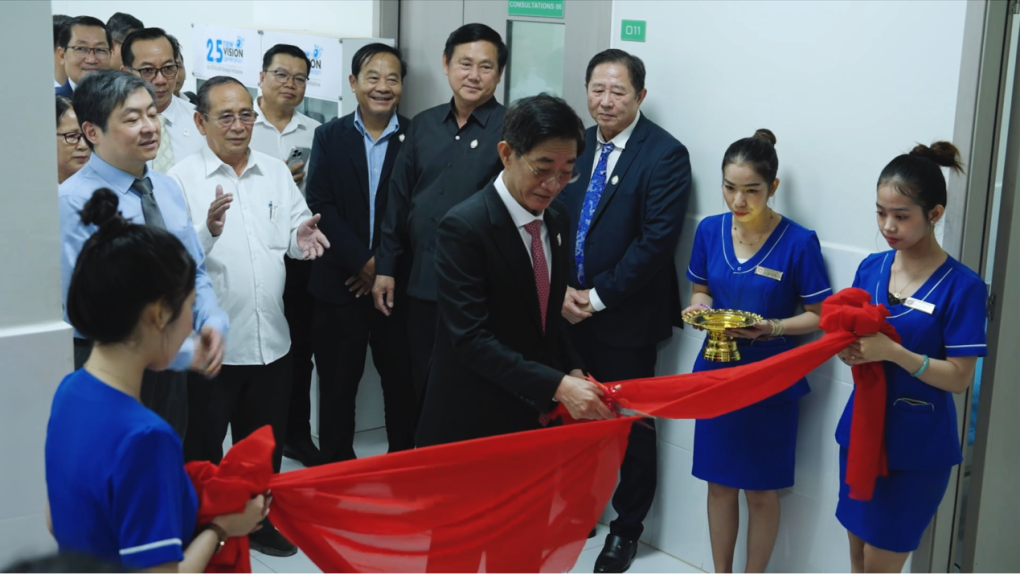
A hospital usually arrives as a new building. In Da Nang last week it arrived on the wings of an MD-10 aircraft. On 28 July, Kathleen Sherwin, Orbis International CEO, welcomed representatives from the Ministry of Health, the People’s Committee of Da Nang City, Da Nang Eye Hospital, FedEx, IAPB and other eye-health partners from across the country and beyond at Da Nang International Airport to open the 2026 Orbis Viet Nam Flying Eye Hospital programme.
It was a milestone with several layers of meaning: the fifth time the Flying Eye Hospital has come to Da Nang; 20 years since the city first welcomed the aircraft in 2006; and 30 years since Orbis began working alongside Vietnam’s eye-health community.
A flying classroom built for lasting change
Inside the aircraft is a state-of-the-art ophthalmic practicing and teaching facility, complete with a classroom, simulation centre, and operating room. Yet the Flying Eye Hospital is not just a hospital that happens to make flying visits. Its central purpose is to share knowledge, strengthen skills, and support local teams to deliver high-quality care for years after the aircraft departs.
Over three weeks, more than 20 volunteer specialists from seven countries are working alongside Vietnamese colleagues to deliver advanced training for more than 230 ophthalmologists, residents, anaesthesiologists, nurses, and biomedical engineers. Training takes place both on board the aircraft and at Da Nang Eye Hospital, bringing together simulation-based learning, surgical mentoring, supervised clinical care and clinical discussion. The trained participants then will serve over 9 million local residents in Da Nang, central and highland region of Vietnam.
The programme focuses on priority areas including cataract, glaucoma, retinal disease – including retinopathy of prematurity – and oculoplastic surgery. By strengthening the capabilities of the people who provide care every day, the project will help expand access to specialised eye services for nearly nine million people across Central Viet Nam and the Central Highlands.
Learning that begins before landing and continues after take-off
The work does not begin when the aircraft lands, and it does not end when it takes off. Cybersight, Orbis’s telemedicine and e-learning platform, connects the in-person programme with continuous learning. Participants can prepare before training, consult international experts, access ongoing education, and continue developing their skills once the Flying Eye Hospital has moved on. Cybersight complements a much broader capacity-building effort that Orbis has supported in Vietnam for nearly 30 years. Through fellowships, simulation-based training, wet labs, mentoring, and partnerships with hospitals and universities, Orbis has helped train more than 40,000 eye care professionals and strengthen sustainable eye care services across the country
This combination of hands-on mentorship, simulation, telemedicine, artificial intelligence, and research reflects Orbis’s wider approach: invest in people, institutions, technology, and local leadership so that improvements are embedded in the health system. Viet Nam is increasingly recognised as a regional leader in areas including paediatric eye care, diabetic retinopathy, retinopathy of prematurity, workforce development, and technology-enabled care. The programme in Da Nang is both a celebration of that progress and an investment in what comes next.
Thirty years of partnership – and a platform for the future
Since 1996, Orbis has worked with government partners, hospitals, universities, and eye-care professionals across Viet Nam to strengthen services and bring care closer to communities. Together, these partnerships have supported the training of more than 40,000 eye-care professionals, reached more than 5.2 million people with eye-care services, and supported more than 139,000 sight-saving surgeries. They have also helped establish or strengthen 17 retinopathy of prematurity centres and 12 vision centres, alongside national clinical guidance and new technology-enabled approaches to screening and care.
These achievements belong above all to the Vietnamese institutions and professionals who now lead and extend the work. Orbis’s role is to stand alongside them: supporting, convening, innovating and helping proven approaches reach more people.
Dr Fabrizio D’Esposito, IAPB’s Head of Region for the Western Pacific, joined the opening ceremony and welcomed the programme as an example of how long-term partnership can help turn ambition into stronger, more sustainable services.
“Vietnam’s progress shows what sustained partnership and investment in local leadership can achieve. The opportunity now is to build on that foundation so quality eye care reaches everyone who needs it. The Flying Eye Hospital is a powerful example of global expertise strengthening systems that are locally led and built to last.”
Looking towards 2030
The Flying Eye Hospital’s return comes at a time of renewed momentum for eye health in Viet Nam and globally. As populations age and conditions such as diabetes become more common, the need for accessible, high-quality eye care will continue to grow. Meeting that need will require the same ingredients that have underpinned 30 years of progress in Vietnam: national leadership, skilled health workers, good evidence, appropriate technology, and committed partners.
During the visit, Orbis was deeply honoured to receive a Ministry of Health award recognizing more than three decades of service and partnership in strengthening eye care across the country. The award reflects the dedication and collaboration of countless partners who have contributed to improving vision and preventing avoidable blindness in Vietnam.
It is also a timely example as governments and partners prepare for the Global Summit on Eye Health in November 2026 where Vietnam’s experiences and achievements can help inform global action. The work underway in Da Nang shows what collective action can look like in practice – international expertise supporting national priorities, learning designed to last, and local leadership at the centre.
In the weeks ahead, patients will receive care and health professionals will gain new skills. The deeper impact, however, will unfold over many years: in the clinics where those skills are applied, in the colleagues who are trained in turn, and in the communities able to access quality eye care closer to home. The aircraft will eventually leave Da Nang. The knowledge, partnerships and local capacity it helps strengthen will remain.