







Join the Leading Global Eye Health Alliance.
Membership-
Choose an alternate language here
- Membership
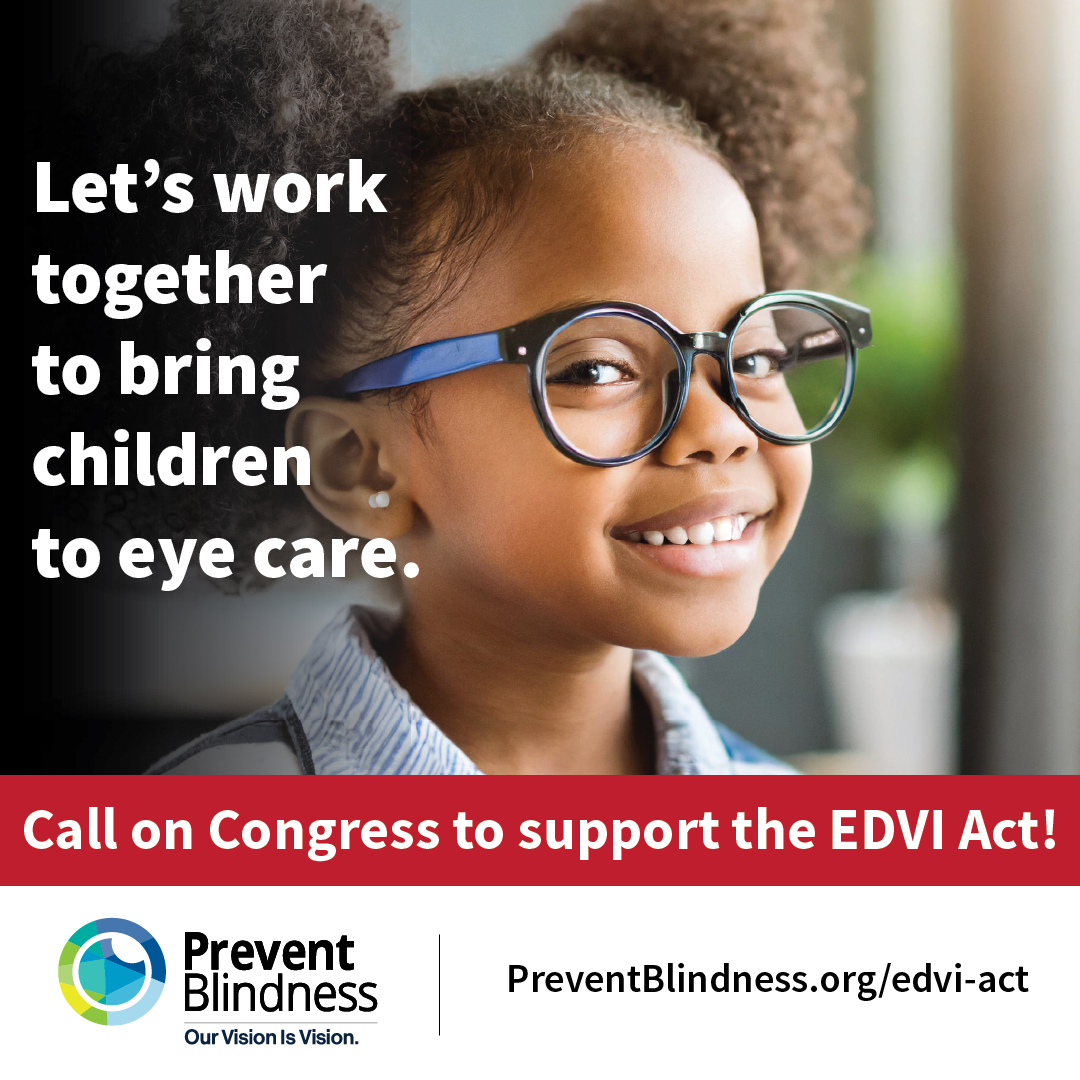
Prevent Blindness applauds the introduction of the “Early Detection of Vision Impairments in Children (EDVI) Act,” in the U.S. House of Representatives and urges the 118th Congress to move swiftly to pass the proposed legislation.
The EDVI Act, which seeks to establish grants for states and communities to improve children’s vision and eye health through coordinated systems of care, is a bipartisan proposal, co-sponsored by Congressional Vision Caucus (CVC) co-chairs, U.S. Representative Gus Bilirakis (FL-12), and U.S. Representative Marc Veasey (TX-33). Companion legislation is expected to be introduced in the U.S. Senate.
“As an American who has suffered from poor vision since childhood, I have a first-hand understanding of how critical early detection and treatment is when it comes to ensuring that all children have the best possible start in life,” said Rep. Bilirakis. “Our landmark bill will ensure all children get the screening and care they need at the right age by creating the first-ever federally funded program to address children’s vision and eye health. This legislation will empower states and communities, like mine, to improve systems of care for our youngest citizens and their families.”
“Children’s vision and eye health is a critical aspect of a child’s healthy development that has been overlooked for far too long,” said Rep. Veasey, the newly appointed Democratic co-chair of the CVC. “Healthy vision plays a key role in each child’s performance in school – when a child cannot see, their education suffers. Texas families and children across the country deserve equitable access to early detection and care for vision issues, whether at school, in the community, or across the healthcare spectrum. The Early Detection of Vision Impairments for Children Act will ensure children, their parents, and their caregivers can access the eye care they need to thrive and succeed.”
Despite the presence of numerous public health programs that support early childhood development, including children’s hearing and oral health, there is currently no federally funded program in the United States that specifically addresses children’s vision or that fosters a cohesive and equitable system of eye health for children.
“More than one in every four children in America, or roughly 19.6 million, have a vision problem requiring treatment,” said Jeff Todd, president and CEO of Prevent Blindness. “We know access to education, screenings, examinations, diagnosis, and treatment are critical to preventing vision loss, and this legislation is an important step in providing children and their families with those services and the healthcare they need and deserve.”
“Vision plays a critical role in children’s physical, cognitive, and social development,” said Donna Fishman, director of the National Center for Children’s Vision and Eye Health at Prevent Blindness. “Without early detection and treatment, uncorrected vision disorders can impair child development, interfere with learning, and even lead to permanent vision loss.”
Visual functioning is a strong predictor of academic performance in school-age children. If left untreated, common vision disorders in childhood, such as amblyopia (lazy eye), strabismus (crossed eyes), myopia (nearsightedness), or hyperopia (farsightedness), may continue to affect health and well-being throughout the child’s life.
Currently, significant disparities exist in children’s vision and eye health outcomes and access to eye care across the United States. State laws to address children’s vision vary widely in approaches and often lack protocols for referrals to eye care providers and documentation to ensure eye care was received. States may also lack the necessary resources to adequately capture data on rates of received eye care, leading to challenges in addressing existing disparities among demographic sub-populations or in rural or under-resourced communities.
Under the EDVI Act, the Health Resources and Services Administration (HRSA) at the U.S. Department of Health and Human Services, will award grants and cooperative agreements for states, communities, and tribes to:
• Implement approaches (such as vision screenings) for the early detection of vision concerns in children, referrals for eye exams, and follow-up mechanisms;
• identify barriers in access to eye care;
• reduce disparities in eye health; and/or
• develop state-based data collection, surveillance, and performance improvement systems.
Resources will also be made available through the Centers for Disease Control and Prevention to establish a national level technical assistance center to provide guidance to any state or community implementing children’s vision programs and to advance population health research priorities in children’s vision.
A broad spectrum of public health organizations support the legislation, including American Academy of Ophthalmology, American Academy of Optometry, American Association for Pediatric Ophthalmology and Strabismus, American Optometric Association, American Society of Ophthalmic Registered Nurses, Association of Clinicians for the Underserved, Association of Maternal and Child Health Programs, Children’s Vision Equity Alliance, Family Voices, Healthy Schools Campaign, National Alliance for Eye and Vision Research, National Association of School Nurses, and the School-Based Health Alliance, among others.
Prevent Blindness is asking the public to show support for the EDVI Act and its goal of promoting children’s vision and eye health by contacting their Members of Congress and asking them to co-sponsor the EDVI Act. Individuals can contact their Representative by visiting the Prevent Blindness Legislative Action Center.
“Implementing the EDVI Act will take a systems-based, coordinated effort among a broad spectrum of stakeholders, including health care professionals, families, patients and the bipartisan leadership of Congress, as we seek to ensure all children have access to the care necessary to avoid preventable vision loss and blindness,” concluded Todd.
For information on the EDVI Act and Prevent Blindness advocacy efforts, please visit https://preventblindness.org/edvi-act, or contact advocacy@PreventBlindness.org.