



Join the Leading Global Eye Health Alliance.
Membership-
Choose an alternate language here
- Membership
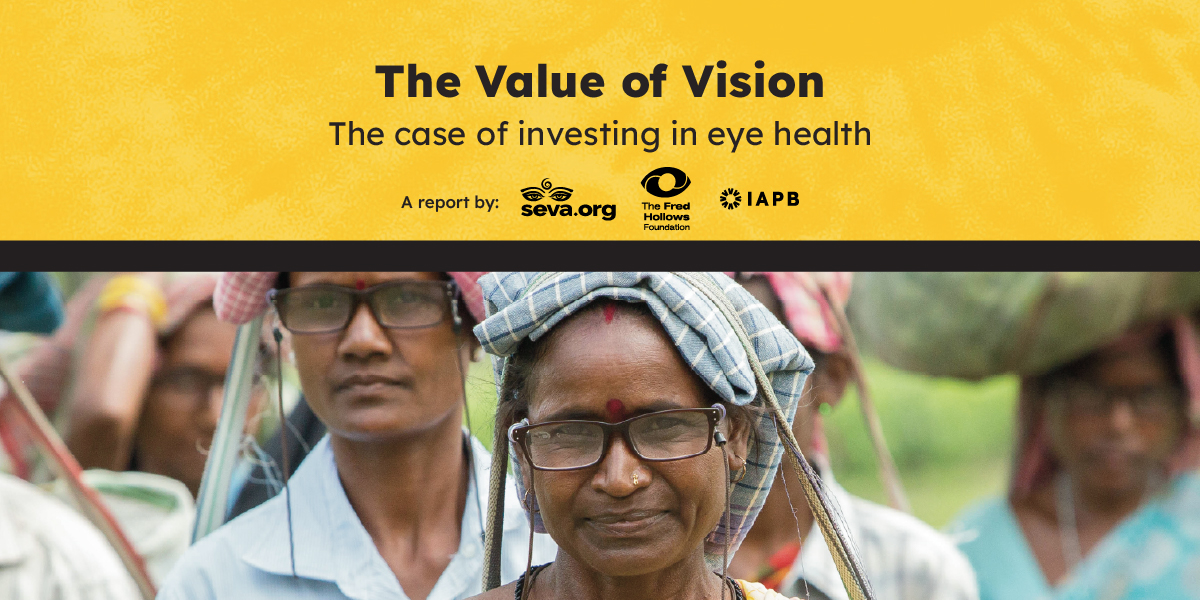
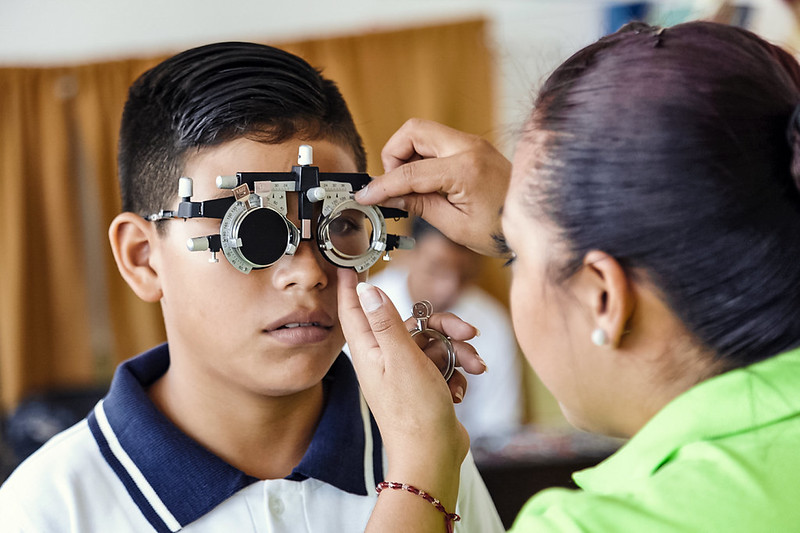
New York: Eye tests in schools and distributing on-the-spot reading glasses are among the simple, cost-effective interventions in low- and middle-income countries (LMICs) that could see a return of $447 billion to the economy annually and 22 million more people employed per year, world-first research reveals.
The Value of Vision report, published by the IAPB, in collaboration with Seva Foundation and Fred Hollows Foundation to coincide with the United Nations General Assembly in New York, shows that delivering on six priority eye health areas will see a $28 return for every $1 invested. This places eye health alongside nutrition as one of the most powerful and cost-effective opportunities to boost global development.
The report, unveiled today during the United Nations General Assembly at a high-level meeting hosted by IAPB and The United Nations Friends of Vision Group, brings together global leaders across Member States, civil society and NGOs to discuss the critical role of preventing sight loss in achieving the Sustainable Development Goals.
Nearly 1 billion people in LMICs live with avoidable sight loss. The crisis is only set to worsen with ageing populations and increasing reliance on screens, and the personal consequences of sight loss are devastating: unemployment, lower educational attainment, mental ill health, social isolation, and increased risk of injury and illness.
The report lays out six priority areas for governments to prevent sight loss:
A $7.1 billion investment in these priorities would recoup $199 billion by 2030. If countries build on this foundation beyond 2030, fully eliminating vision impairment would unlock $447 billion every year. The transformative impact would generate annual benefits equivalent to 13 million extra years of schooling, 22 million more people employed, and 304 million people relieved of unpaid caregiving, predominantly women.
In his keynote address, during the high-level meeting hosted by IAPB and The United Nations Friends of Vision Group, Gaston Browne, Prime Minister of Antigua and Barbuda, will urge Member States to take concrete steps and develop national roadmaps ahead of the 2026 Global Summit for Eye Health, officially announced today.
The Summit will be the first of its kind, bringing together governments, multilaterals, civil society, and the private sector to provide a global platform for countries to present their progress, agree to a unified policy and commitment framework, and mobilise new financial and political commitment to ensure eye health is fully integrated into health and development strategies worldwide.
Gaston Browne, Prime Minister of Antigua and Barbuda, will say in his address at UNGA:
“Five years ago, this General Assembly achieved the adoption of the “Vision for Everyone” resolution, a landmark agreement that committed us all, as leaders, to ensuring eye care reaches those who need it most. But five years on, not enough progress has been made.
“There are still children losing out on education because they cannot read a book or see a blackboard properly. There are still workers leaving their jobs because they cannot see well enough to be safe or productive. There are still elders unable to help their families or contribute to society in the way they can and should.
“Unlike some difficult and complex policy issues, eye health already has solutions that are affordable and implementable. What is needed now is action to get these solutions to the people who need them.”
“For small states like Antigua and Barbuda, the potential return on investment is clear. Investing in eye health is a smart economic strategy. It is a way to unlock jobs, productivity, growth and prosperity for all.”
Peter Holland, CEO of IAPB, says:
“Vision loss is a truly universal problem, but has often been sidelined in global development discussions. It impacts nearly every part of our lives: our ability to learn, find employment, our earning potential, and our mental health. This comes at a tangible cost not just for individuals, but for families, communities and economies.
“Eye health is one of the most powerful ways governments can build stronger economies. But we know there are significant barriers to overcome. We must tackle the stigma around glasses and sight loss that prevents people from seeking help. Eye health has also been siloed from wider healthcare, with fragmented systems and a workforce that in many places can’t meet the demand.
“But we have practical, affordable solutions. Ahead of the Global Eye Health Summit next year, we must work together across sectors to integrate eye care into national health, social and economic systems and make it accessible and affordable for all.”
Brad Wong, Chief Economist at Seva Foundation, says:
“Our analysis shows that investing in eye health is not only transformative for individuals, but also one of the smartest economic decisions governments can make. Simple, proven interventions like school screenings, cataract surgery, and ready-made reading glasses deliver outsized returns.
“Our analysis goes beyond headline figures to capture the multi-sectoral benefits of vision. Improved sight translates into measurable gains in labour force participation, higher educational attainment, and worker productivity. By quantifying these cross-cutting impacts, we can show governments and development banks that eye health is not a marginal issue but an investment with consistent, long-term returns across the whole economy.
“By 2030, these measures could return hundreds of billions to the global economy each year. The evidence is clear: eye health is no longer a peripheral issue. It is central to driving sustainable growth.”
Jack Hennessy, Senior Health Economist, The Fred Hollows Foundation, said:
“Eye health interventions consistently rank among the most cost-effective in the world. These aren’t treatments and solutions that we’re searching for – they’re here right in front of us.
“Our research provides a roadmap of low-cost, actionable interventions for Governments and donors to invest in over the next five years to realise the enormous health, social, and economic benefits to restoring sight.
“We have demonstrated that eye health is fundamentally a development issue that can lead to benefits ranging from economic productivity improvements to averted road traffic accidents and reduced incidence of poor mental health.
“The benefits of restoring sight to individuals, families, communities, and the broader economic and social environment are clear. We show how such interventions can be nationally and globally scaled at extremely low-cost, proving that eye health truly is one of the best investments in global health.”
To learn, explore the research, visit the IAPB Vision Atlas.