







Join the Leading Global Eye Health Alliance.
Membership-
Choose an alternate language here
- Membership
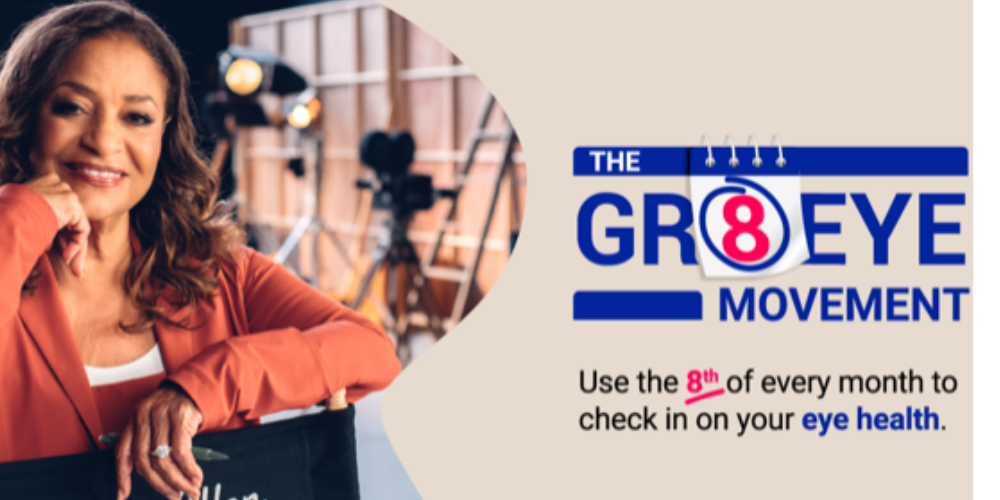
New survey shows that 95% of adults at risk for certain retinal diseases know a little or nothing about them. Allen hopes her story will help raise awareness and encourage those at risk to regularly prioritize their eye health
CHICAGO (Sept. 8, 2023) – Award-winning actress, dancer and director Debbie Allen joins Prevent Blindness and Regeneron to launch the Gr8 Eye Movement, a new disease awareness campaign that aims to address gaps in how people understand the risk of developing certain serious retinal diseases, such as wet age-related macular degeneration (wAMD), diabetic macular edema (DME) and diabetic retinopathy (DR). The campaign creates a moment in time to prioritize eye health regularly by designating the 8th of every month as a day to check in on vision. The number “8” on its side looks like eyes and serves as a visual reminder for those who join the movement.
“Maintaining vision has become a growing priority in my life. In particular, I’ve learned it’s crucial for people like me — who are from communities of color, are over the age of 60, or who are living with diabetes or at risk of developing diabetes — to educate themselves about the risk of developing a retinal disease,” said Allen. “Diabetes has impacted many generations of my own family, and I have had family members blinded by diabetic eye disease. Also, as I age, I know I could be at risk for developing other retinal diseases like wet age-related macular degeneration that could potentially hinder me from doing the things in my life I love most. This is why I’m joining the Gr8 Eye Movement – to encourage anyone at risk to check their eye health regularly.”
Retinal diseases impact a significant number of Americans. Almost 20 million Americans are living with some form of age-related macular degeneration (AMD) 2, the most common cause of irreversible blindness among the elderly age group. The advanced form of AMD is wet AMD, where vision loss can be very rapid if untreated.4
Diabetes is a leading cause of new blindness in the United States. 5 Consistently high blood sugar due to poor glucose control over time can damage small blood vessels in the body, including the eye. Diabetic retinopathy is a disease that damages the blood vessels in the retina, resulting in vision impairment. Left untreated, fluid can leak into the center of the macula, called the fovea, the part of the eye where sharp, straight-ahead vision occurs. The fluid makes the macula swell, blurring vision. This condition is called DME.5
“For 115 years, it has been our mission to prevent blindness and preserve sight,” said Jeff Todd, President and CEO, Prevent Blindness. “The learnings from our recent survey, along with the robust insights gleaned through our work in patient advocacy and public health, demonstrate the significant need for further awareness and education. It’s inspiring to have an icon like Debbie Allen joining the cause and encouraging others to prioritize their eye health.”
A recent survey of at-risk adults* found that an overwhelming majority (95%) lack knowledge about retinal diseases like wAMD, DME and DR, and therefore are not taking the necessary, proactive steps to take care of their vision. Survey findings indicate that most at-risk adults (67%) believe that vision loss is a normal part of aging. This is even as more than two-thirds of at-risk adults (70%) have experienced symptoms of retinal disease. However, the survey responses also indicate that, once equipped with knowledge about retinal diseases and their risk factors, a majority of those at risk (79%) will take steps to address changes in their vision. These insights underscore the importance of education and awareness.
“Regeneron is proud to collaborate with Prevent Blindness and Debbie Allen, to raise awareness of retinal diseases and the importance of getting regular eye health exams. The ability to see is a critical part of our lives, and people who are at-risk should be aware that retinal diseases can have an impact on their vision,” said Kevin Clark, Vice President of the Ophthalmology Commercial Business Unit at Regeneron. “With the Gr8 Eye Movement, we are working to help close the gap in retinal disease awareness and offering a simple way for people to remember to make their eye health a priority.”
To learn how you can join the movement, visit www.Gr8EyeMovement.com, where you can:
*This survey was conducted by Wakefield Research, which collected findings from 667 adults age 55+ who are at risk for retinal diseases; from May-June, 2023.