


Join the Leading Global Eye Health Alliance.
Membership-
Choose an alternate language here
- Membership

It began with Wominjeka (welcome); to Wurundjeri Country. From 27 to 30 April, more than 6,000 delegates from over 189 countries gathered in Naarm (Melbourne) for Women Deliver 2026 (WD2026). It was the first time the world’s largest gender equality conference has been hosted in the Oceanic Pacific, and that geography mattered. First Nations leadership, regional voices and lived experience shaped the agenda from the opening plenary onwards, a powerful reminder that global commitments only land when they are grounded in local realities.
Three years on from Kigali, the mood in Melbourne felt sharper. The Melbourne Declaration for Gender Equality, launched at the close of the conference and already endorsed by ten countries and more than 200 organisations, names that which so many of us have felt for some time. That the problem is not a lack of promises, it is a failure to deliver on them. As Women Deliver President Dr Maliha Khan put it, what comes next must be defined by accountability to people, and not just to systems.
That call, to move from commitment to delivery, is one I want to sit with, particularly through the lens of eye health.
Of the 1.1 billion people living with vision loss that could be prevented or treated, 55% are women and girls, the majority of them living in low- and middle-income countries. This is not a failure of medicine. It is a failure of systems, priorities and the everyday barriers that determine whose eye care gets paid for, whose appointment gets kept, and whose right to see is treated as essential.
At our concurrent event, Seeing Gender-Equal Development: Elevating Eye Health beyond Vision; co-hosted with Sightsavers, IAPB, UN Women, Orbis, Seva Foundation and the Alliance for Gender Equality and UHC, I was struck by something deeply familiar from Kigali in 2023: almost everyone I spoke to was surprised both by the gender gap in vision loss and by the catalytic role eye health can play in unlocking opportunity for women and girls. When a woman or girl can see well, she is better able to learn, earn, lead, care for those she loves, and participate fully in society. Vision is not peripheral. It is a cornerstone of bodily autonomy, education, economic participation and dignity.
This conversation did not start in Melbourne. In February, we convened ministers, eye health leaders, civil society and women’s rights advocates in Fiji to launch the Pacific Pathways Communiqué, a public call to action for gender-equitable eye health in the Blue Pacific. It calls for integrating eye health into primary and community care, strengthening workforce pipelines and women’s leadership, protecting dedicated financing aligned with climate resilience, improving disaggregated data, and investing in community-led, gender-responsive solutions. The conversations in Melbourne built directly on that regional momentum.
These conversations at WD2026, across plenaries on bodily autonomy, the care economy, climate justice and adolescent girls, made one thing very clear: the barriers preventing women and girls from accessing eye care are the same barriers that show up across the wider gender equality agenda. They are structural, not incidental. The cost of services and transport. The unpaid care load that crowds out a woman’s own appointment. Restrictions on mobility and decision-making within the household. Gender-blind data that erases the problem before it can be named. And a humanitarian and climate context in which up to 80% of those displaced are women and girls, for whom vision impairment compounds risk in every emergency.
The launch in Melbourne of the Feminist Health Systems Charter, which drew interest from The Lancet and from governments including Mexico, offers exactly the systems lens we have been calling for. Eye health must be embedded inside that charter, and inside national Universal Health Coverage packages, not bolted on. Adolescent girls were rightly centre-stage at WD2026, through the Girls Manifesto and the new Adolescent Girls Era Campaign; uncorrected refractive error and trachoma in girlhood derail the same education and economic outcomes the wider movement is mobilising around. We have a collective responsibility to make those connections visible.
If WD2026’s central message is to shift power, then our sector has work to do at home. The latest IAPB Gender Equity Work Group survey, which I had the privilege of presenting alongside colleagues on a panel about how organisations can better support women leaders in eye health, shows progress, but not enough. Women now make up just over 30% of CEOs in eye health, but hold only 17.8% of Chairs roles. Only 63% of organisations disaggregate their data by sex which means over one third of organisations that respond, don’t. Globally, women are over 70% of the health (and eye health) workforce, yet hold just 25% of leadership roles.
We cannot credibly call for a power shift in the wider gender equality movement if we are not delivering one in our own. Reframing who leads eye health is not a ‘nice to have’ add-on; it is a core competency for any organisation serious about ending avoidable blindness. The recognition of Papua New Guinean ophthalmologist Dr Jambi Garap as the inaugural recipient of the Gabi Hollows Award for Women Advancing Global Health and Development was, for me, one of the most hopeful moments of the week, a reminder that the leadership we need is already here, often locally led, often under-resourced, and ready to be backed.
I leave Melbourne with the same conviction I left Kigali: we must not lose this momentum. The Melbourne Declaration gives the whole sector, including ours, a shared reference point for accountability. For eye health, that means three things: embed gender equity in every national plan and every UHC package; invest in, and disaggregate data, so we can finally see who we are missing; and back the women already leading change in our sector with funding, governance seats and the platforms they deserve.
That momentum carries forward immediately. On 4 June in Nairobi, we will convene an adapted version of the Fiji meeting for the Africa region, on the sidelines of IAPB’s 2030 In Sight Live conference. Different geography, but the same conviction: that gender-equitable eye health is a matter of justice, resilience and economic participation, and that the regional leaders closest to the issue must shape what comes next.
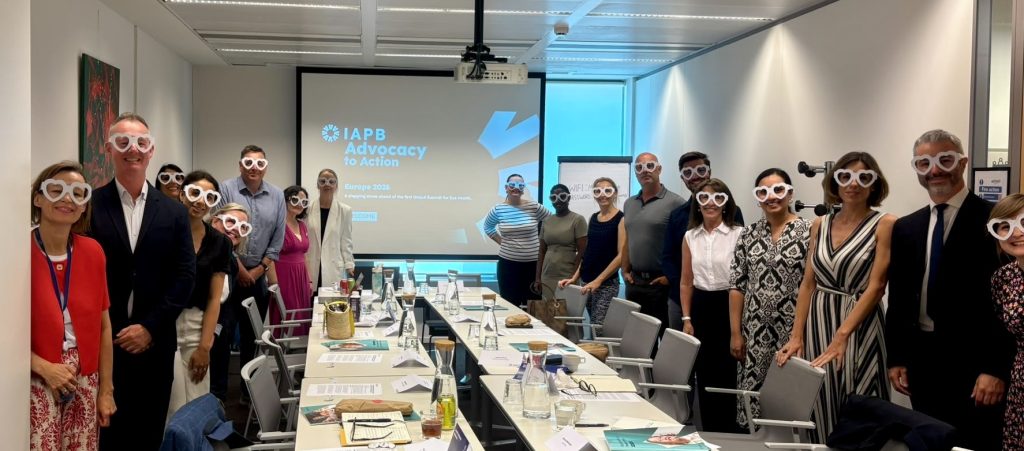
When we were in PNG in April conducting a workshop with Dr Jambi, Caroline Casey, IAPB President, asked me what, in my opinion, would make the biggest difference to gender equity in eye health. I said, we are not short of evidence and we know the cost. What we need now is intentional action; at scale, and with accountability. Because gender-equitable eye health is not a side issue. It is fundamental to justice, resilience and economic participation. And the time to deliver it is now.