



Join the Leading Global Eye Health Alliance.
Membership-
Choose an alternate language here
- Membership
LONDON, August 25, 2022] The Global Myopia Awareness Coalition, a group of leading ophthalmic companies and eye health associations, is launching a new campaign in the UK to educate parents on the dangers of screen time in a bid to help safeguard children’s future eye health.
This comes after new research revealed that more than a third of children (36%) are being exposed to potential eye health problems during the school holidays after spending upwards of five hours a day glued to screens.
The study of 1,500 parents, commissioned by the Global Myopia Awareness Coalition (GMAC), showed only 21 per cent of parents worry about overuse of screens and how it might affect their child’s eye health and four in 10 did not realise extended periods on screens can be a leading cause for eye problems, like myopia.
In a bid to stem the surge of myopic youngsters, the Global Myopia Awareness Coalition has set parents a challenge to pry themselves and their children away from the screens over the Bank Holiday. They have produced, with support from Optometrist Keyur Patel, an effective Screen Staycation Guide to give ideas on a range of activities to help break the urge to view and introduce parents to solutions that could slow down the progression of their child’s myopia.
Global Myopia Awareness Coalition UK Lead, Matt Oerding said: “With myopia growing so rapidly amongst children, we felt it was imperative to alert parents to the impact extended periods of screen-time can have on children’s eye health. We know that in the school summer holidays, children may spend a lot of their days off watching TV or playing on devices, and so to support the future of children’s long-term eye health, we want to encourage parents to get their children taking part in ‘sight saving’ activities and screen-free swaps this Bank Holiday weekend. Just 76 extra minutes outside a day can reduce the risk of myopia by 50%i – so let’s start now.”
After launching a series of successful campaigns in the US, the Global Myopia Awareness Coalition is now expanding globally, with the UK being the next biggest market. Mr Oerding continued and said: “Childhood myopia is one of the major public health challenges of our time and is of huge concern as its prevalence in children aged 10-16 has more than doubled in the last 50 years.ii The myopia crisis is set to grow even further in 2050, with 50% of the global population expected to have myopia and 10% will have high myopia.iii
“If not managed, it can impact children’s performance at schooliv and worsening myopia may also impact long-term eye health.v Myopia significantly increases a child’s risk for more serious eye diseases such as retinal detachment, glaucoma, or myopic maculopathy later in life.iv It’s so important we take steps now to protect children’s vision, in the future”
The study also highlighted that parent are putting their kids’ long-term eye health at risk by failing to prioritise eye tests. Despite eyecare professionals warning they are essential to help lower the risk of long-term eye health problems; the research revealed a third (31%) of parents have never had their children’s eyes tested. Furthermore, around four in 10 parents (38 per cent) confessed to not knowing the signs or symptoms of myopia they should be looking out. And 42 per cent were not aware that myopia is irreversible or incurable.
Last year, the World Council of Optometry (WCO) announced that myopia management should be a standard of care for childhood myopia.vi In this, the WCO stated that ECPs should shift from just correcting vision to managing the condition, educating parents on myopia and the lifestyle that may impact it, as well as the risks to long term ocular health and the available strategies which may slow its progression.vi
Despite this, research from GMAC revealed that a third (30%) did not know there are ways you can slow down the progression of the condition. Yet, of those who have never taken their children to the opticians, 35 per cent think their child is displaying at least one symptom of possible eye issues, including sitting close to a whiteboard (13%) and headaches (12%).
Optometrist Dr Keyur Patel, who is working with GMAC, said: “Myopia is on the rise in children, and has become a global health issue, so regular eye examinations are important to identify any problems. It is an irreversible disease and can be a barrier to a child’s ability to do their best and fulfil their potential. Early intervention has an impact on young children, which is important parents and ECPs are aware of – the earlier we intervene, the more impact we can have on that final level of myopia.”
For more information on the Global Myopia Awareness Coalition, visit: MyopiaAwareness.org/UK
i Myopia Awareness, https://www.myopiaawareness.org/screen-staycation, Last accessed: July 6 2022
ii McCullough SJ, O’Donoghue L, Saunders KJ. Six Year Refractive Change among White Children and Young Adults: Evidence for Significant Increase in Myopia
among White UK Children. PLoS One. 2016 Jan 19;11(1):e0146332. doi: 10.1371/journal.pone.0146332
iii Holden BA, et al. Global Prevalence of Myopia and High Myopia and Temporal Trends from 2000 through 2050. Ophthalmology. 2016; 123(5): 1036–1042.
iv Shelley Hopkins, Sumithira Narayanasamy, Stephen J Vincent, Geoff P Sampson, Joanne M Wood, Do reduced visual acuity and refractive error affect
classroom performance? 2020 May;103(3):278-289. doi: 10.1111/cxo.12953. Epub 2019 Aug 224.
v Flitcroft DI. The complex interactions of retinal, optical and environmental factors in myopia aetiology. Prog Retin Eye Res. 2012;31:622-60.
vi World Council of Optometry. Resolution: The Standard of Care For Myopia
Prevent Blindness is declaring February as Age-related Macular Degeneration (AMD) and Low Vision Month in an effort to provide education and various expert-approved resources to the public and professionals. This year’s AMD and Low Vision Month is generously supported by Gold Sponsor EyePoint, Inc.
According to Johns Hopkins Medicine, AMD is the most common cause of severe loss of eyesight among people 50 and older. And, about 4 million Americans live with low vision, which is defined as chronic visual impairment that cannot be corrected with glasses, contact lenses or medical treatments.
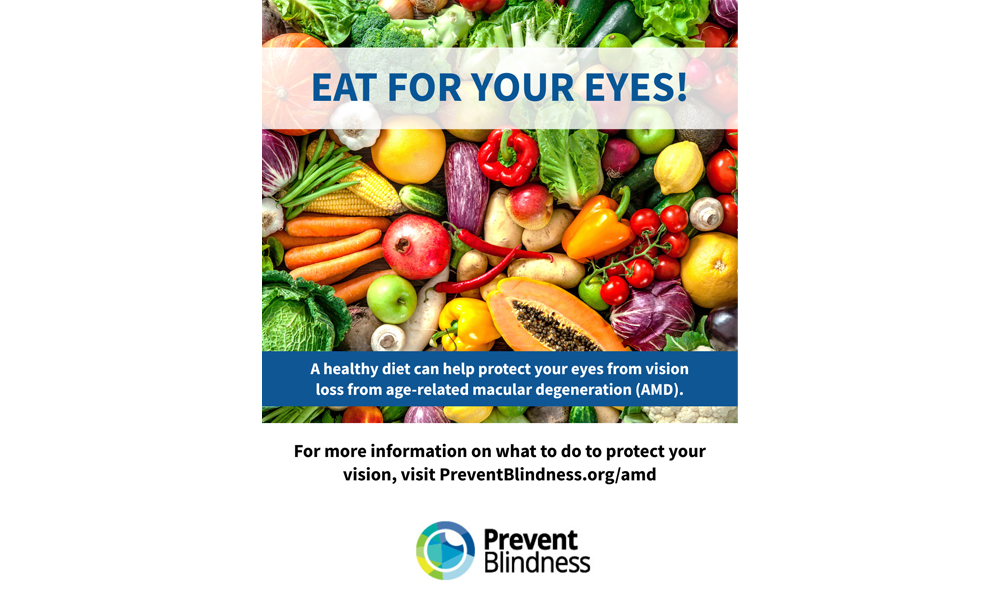
AMD affects the central part of the retina called the “macula.” When AMD damages the macula, the center part of a person’s vision may become blurred or wavy, and a blind spot may develop. Early detection and treatment of AMD is key to helping to prevent significant vision loss.
Two types of AMD include:
“As our population ages, the number of individuals impacted by AMD continues to grow. Many will face difficulties doing the things we sometimes take for granted, such as reading, seeing faces, and driving,” said Jeff Todd, president and CEO of Prevent Blindness. “Our robust collection of resources on AMD and low vision are intentionally created to help minimize vision loss and maintain independence for those impacted by AMD while providing effective tools to the public and providers on ways to save sight.”
As part of AMD and Low Vision Month, Prevent Blindness offers the free AMD GuideMe app. This resource provides a customized overview of AMD along with a tailored resource list and suggested steps to help save sight from the eye disease specific to the individual using the GuideMe app. Prevent Blindness offers additional educational resources including fact sheets and shareable social media graphics in English and Spanish, and dedicated webpages.
New this year, as part of the Prevent Blindness ASPECT Patient Engagement Program Member Spotlight Series, graduate Laurie S., shares her experience with AMD, including her family history with the eye disease, how it impacts her daily activities including the ability to read music, and the importance of support groups “Age-related Macular Degeneration: Laurie’s Story.”
Videos in the Prevent Blindness Focus on Eye Health Series include:
The Prevent Blindness “Living Well With Low Vision” program provides useful information to those with low vision, their care partners and healthcare professionals. Content includes self-help guides, resources for vision loss and mental wellness, information on clinical trials, and much more. Living Well With Low Vision is supported by grants from Amgen and Genentech.
For more information on AMD, please visit PreventBlindness.org/amd. For information on geographic atrophy, please visit PreventBlindness.org/geographic-atrophy.
And, for more information on Living Well With Low Vision, or other general eye health information, please visit lowvision.PreventBlindness.org.
For a listing of organizations and services that provide financial assistance for vision care in English or Spanish, please visit https://preventblindness.org/vision-care-financial-assistance-information.